Woods, Frederick S. (Frederick Shenstone), 1864-, Bailey, Frederick H. (Frederick Harold), 1865- · Boston, New York [etc.] Ginn and Company · leaf 101
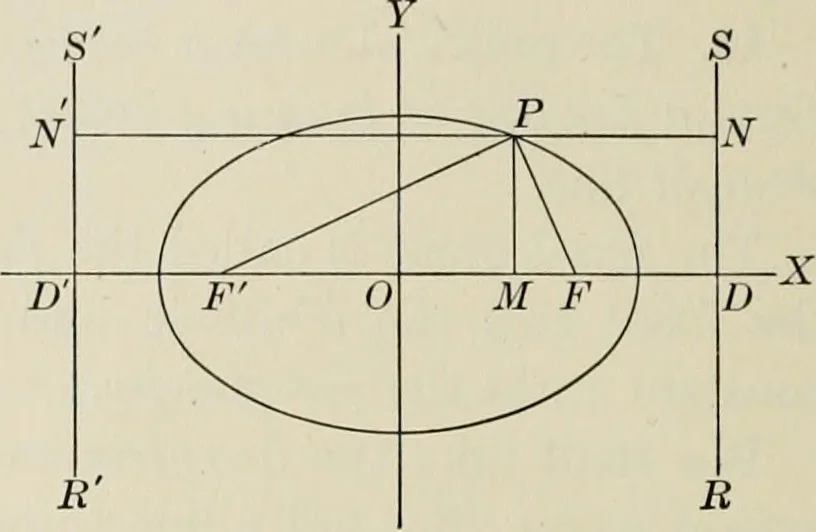
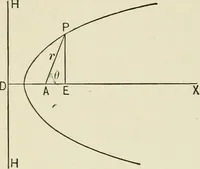
e latter becomes that of the former when e = 1. It is also not difficult to show that the ellipse is a special caseof a conic, where the eccentricity is e of § 38 and < 1. 84 (KIM1 AIN CURVES r If For if P (fig. 79) is a point on the ellipse -- + ~- = 1, we foundin § 38 that a FP = a- ex, FP = a… … Fig. 79 Therefore --X = 0D- OM=MD = PN, e - + x=I)0+OM=DM=NP. e FP = e- PN, FP = e • NP. The ellipse has, therefore, two directrices at the distances ± - e from the center. When the ellipse is a circle, e = 0 and thedirectrices are at infinity. In a similar manner we may show that the hyperbola is…
Geometry, Analytic · Calculus
Internet Archive · California Digital Library · Public Domain Mark 1.0. Free to use for anything.