A compendium of astronomy; containing the elements of the science, familiarly explained and illustrated, with the latest discoveries. Adapted to the use of schools and academies, and of the general reader (1850)
Olmsted, Denison, 1791-1859 · New York, R. B. Collins · leaf 110
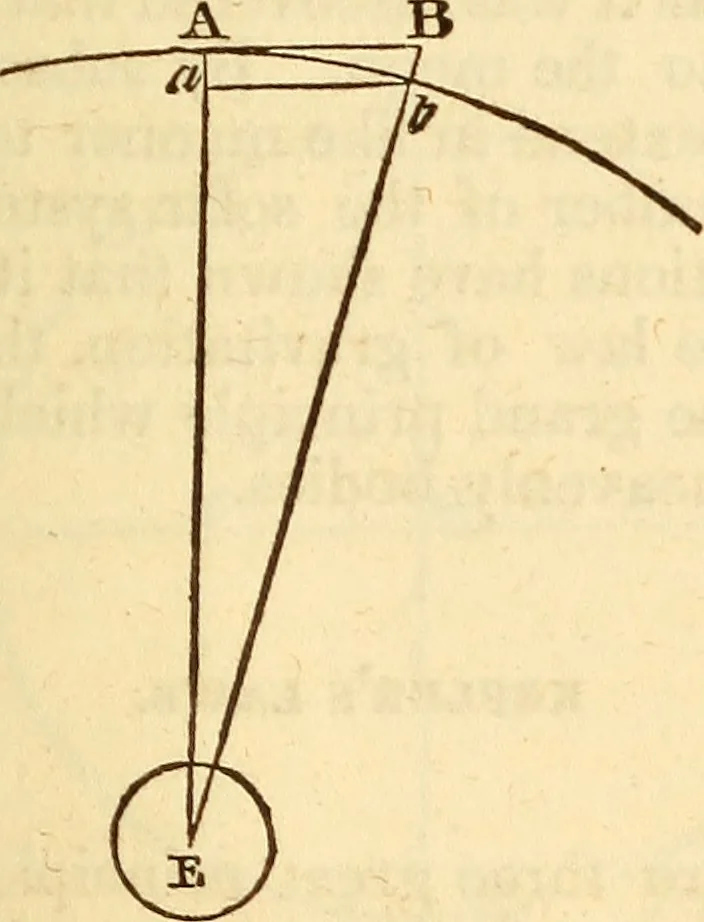
rce, which divertsher from a straight course. For let the earth (Fig. 25,)be at E, and let the arc described by the moon in onesecond of time be Ab. Were the moon influenced byno extraneous force, to turn aside, she would have de-scribed, not the arc Ab, but the straight line AB, andwould have been… … This deviation from the tangent must be owing to someextraneous force. Does this force correspond to whatthe force of gravity exerted by the earth, would be atthe distance of the moon ? The question resolves itselfinto this: Would the force of gravity exerted by theearth upon the moon, cause the…
Astronomy
Internet Archive · Library of Congress · Public Domain Mark 1.0. Free to use for anything.
![An illustration from Nicolai Copernici Torinensis De reuolutionibus orbium coelestium, libri VI : Habes in hoc opere iam recens nato, & aedito, studiose lector, motus stellarum, tam fixarum, quàm erraticarum, cum ex ueteribus, tum etiam ex recentibus obseruationibus restitutos: & nouis insuper ac admirabilibus hypothesibus ornatos. Habes etiam tabulas expeditissimas, ex quibus eosdem ad quoduis tempus quàm facillime caculare poteris. Igitur eme, lege, fruere. [Line in Greek] (1543)](https://img.insideoutlibrary.com/img/200/ia-nicolaicopernici00cope-400-277.webp)