A compendium of spherical astronomy with its applications to the determination and reduction of positions of the fixed stars (1906)
Newcomb, Simon, 1835-1909 · New York, The Macmillan company; London, Macmillan and co., ltd. · leaf 112
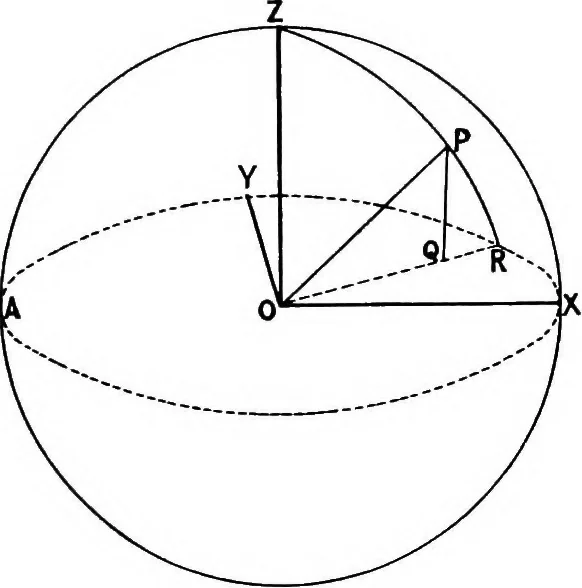
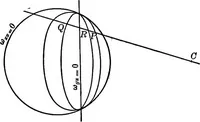
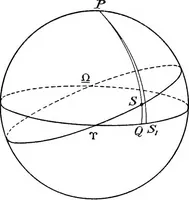
circle AYX is that in which the fundamental plane ofX Y intersects the sphere. P is the point of intersection of theradius vector of a heavenly body with the sphere. ZPR is a §44.] THE CELESTIAL SPHERE 91 quadrant from Z through P to R. The angle POQ,, which wehave called the latitude of the body,… … Fig. 6. by the angle XZR at the vertex Z or by the dihedral anglebetween the planes XOZ and ROZ. The point Z in which the fundamental axis intersects thesphere is called the pole. The polar distance is, in the abstract, a more convenient co-ordinate th&n the latitude, because it is always…
Spherical astronomy · Stars
Internet Archive · Cornell University Library · Public Domain Mark 1.0. Free to use for anything.