Mechanics of engineering (solids) : comprising statics and kinetics of solids, and the mechanics of the materials of construction, or strength and elasticity of beams, columns, shafts, arches, etc. : for use in technical schools (1911)
Church, Irving P. (Irving Porter), 1851-1931 · New York : Wiley ; London : Chapman & Hall · leaf 126
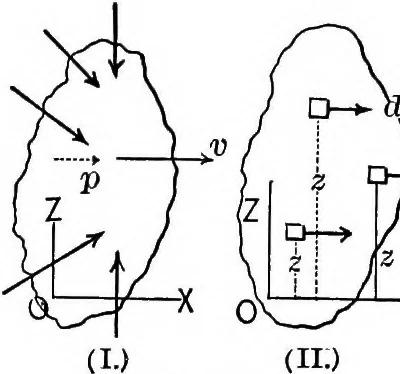
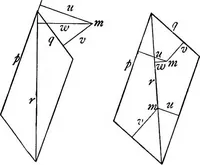
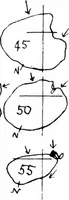
n.—Fig. 122. At a given instant all the par-ticles have the same velocity = v, in pai-allel right lines (par-allel to the axis X, say), and thesame acceleration p. RequiredJMp the ^X of the acting forces, / imaginary equivalent system, con- sisting of a force = mass X ace.^ = <^J!/^ applied… … FlQ. 12J we have (2X)j =/pdM =p/dM = Mp. (V.) It is evident that the resultant of system (II.) must be paral-lel to X; hence* that of (I.), which = {2X)j and may be de-noted by H, must also be parallel to X; let a = perpendiculardistance from B to the plane YX; a will be parallel to Z.Now put…
Mechanics, Applied · Strength of materials
Internet Archive · Cornell University Library · Public Domain Mark 1.0. Free to use for anything.