Steinitz, William, 1836-1900 · New York [etc.] : G.P. Putnam's sons · leaf 33
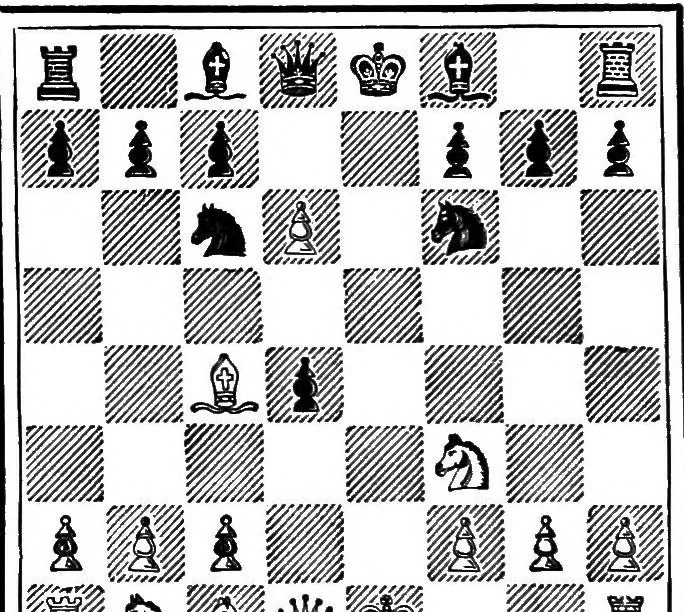
y in- tercept him in his passage as if he had only moved one square. For instance, after the moves I P— K4, i P— K4 ; 2 KKt— B3, 2 QKt— B3 ; 3 P— Q4, 3 PXP ; 4 B— B4, 4 Kt— B3 ; 5 P— K5, 5 P— Q4 ; White's King's Pawn may capture the Pawn which has just advanced two squares as if it had only moved… … ^.gj But the capture "en passant" must be effected at once on the move, for the adverse Pawn cannot be thus taken subsequently. Only Pawns — not pieces — can capture or be captured ' ' en passant. " The Pawn was not allowed formerly the privilege of taking "en passant," the rule having been first…
Chess
Internet Archive · Cornell University Library · Public domain (published before 1931). Free to use for anything.