An elementary treatise on modern pure geometry (1893)
Lachlan, Robert · London, New York, Macmillan and Co. · leaf 204
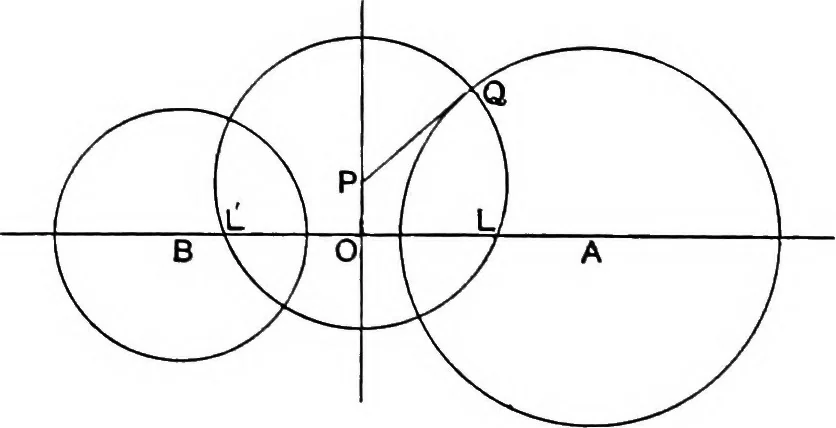
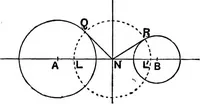
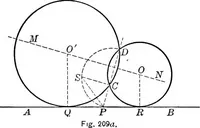
cuts two given circlesorthogonally, the radius of the circle is equal to the tangent drawnfrom P to either of the given circles. Hence P must be a pointon the radical axis of the circles. Hence we infer that only one circle can be drawn -to cut threegiven circles orthogonally. The centre of this… … Let A and B be the centres of the given circles; and let OPbe their radical axis, cutting .^ jB in the point 0. Let any circlewhich cuts the circles orthogonally meet AB in L and L; and letP be the centre of this circle. Then PL = P(^ = PA- A Q. Therefore OL^ = OA-AQ\ Hence the circle whose centre…
Geometry
Internet Archive · Cornell University Library · Public Domain Mark 1.0. Free to use for anything.