Tanner, J. H. (John Henry), b. 1861, Allen, Joseph · New York, American Book Co · leaf 46
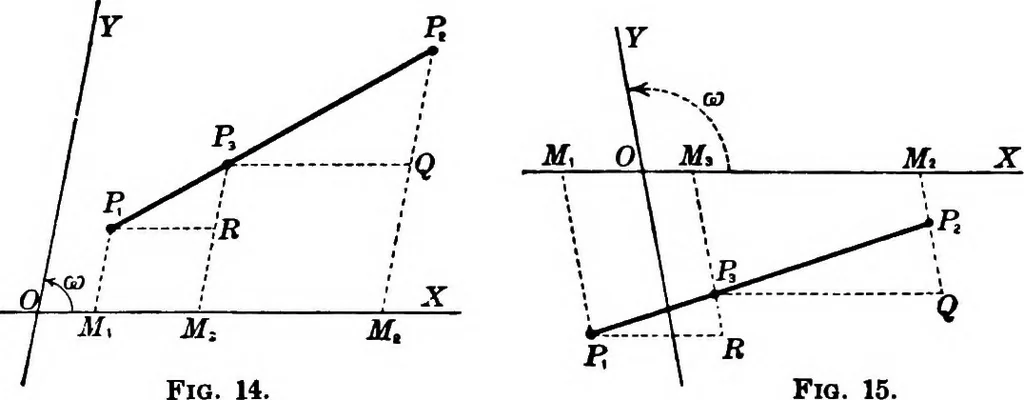
nts all lie on the same straight line. 3. Are the points (2, 3), (1, 3), and (3, 9) coUinear ? 4. Prove that the area of the triangle formed by the points(0, 0), (a, b), and (mc, md) is m times the triangle formed bythe points (0, 0), (a, b), and (c, d). 5. Derive formula [6] from the relation A =… … FiQ. 15. Pi = (a;,, y,) and Pj = (^211/2) be the two given points, P3 = (a;,, ^3)the required point, and let the ratio of the parts into which P3divides P1P2 be j/ii: wij; i.e., let P1P3: P3P2 = wii: wij. Draw theordinates JfiPi, M-iP^, M^P^, and through P, and P3 draw lines 30 GEOMETRIC…
Geometry, Analytic
Internet Archive · Cornell University Library · Public Domain Mark 1.0. Free to use for anything.