Cyclopedia of textile work; a general reference library on cotton, woolen and worsted yarn manufacture, weaving, designing, chemistry and dyeing, finishing, knitting, and allied subjects (1911)
American School of Correspondence · Chicago, American School of Correspondence · leaf 364
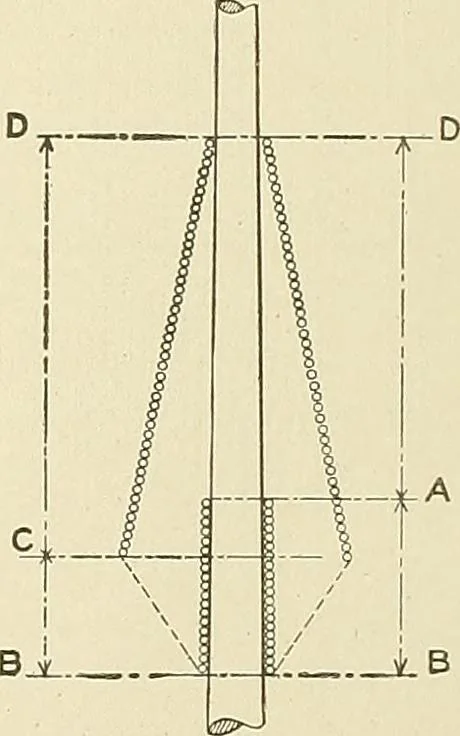
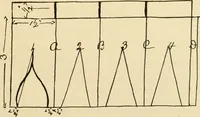
position, the fallerrises slowly until it reaches the same height as the starting point.This will cause the yarn to wind on to the spindle, as shown in Fig.238, by the distance C to D. The distance, C to D, is considerablygreater than the distance, A to B, and the finishing point, D, hasrisen from… … Fig. 238. Diagram of CopShowing winding. COTTON SPINNING 287 The way to overcome this is to have a loose incline as shownin Fig. 239. The builder rail, H, I and J, is made in two pieces, the surface,H-I, is hinged to J at I. By this means, it is possible to lower thepoints, H and J, as much as is…
Textile fabrics · Textile industry
Internet Archive · Library of Congress · Public Domain Mark 1.0. Free to use for anything.