An elementary treatise on mechanics, embracing the theory of statics and dynamics, and its applications to solids and fluids (1849)
Smith, Augustus William, 1802-1866 · New York, Harper · leaf 43
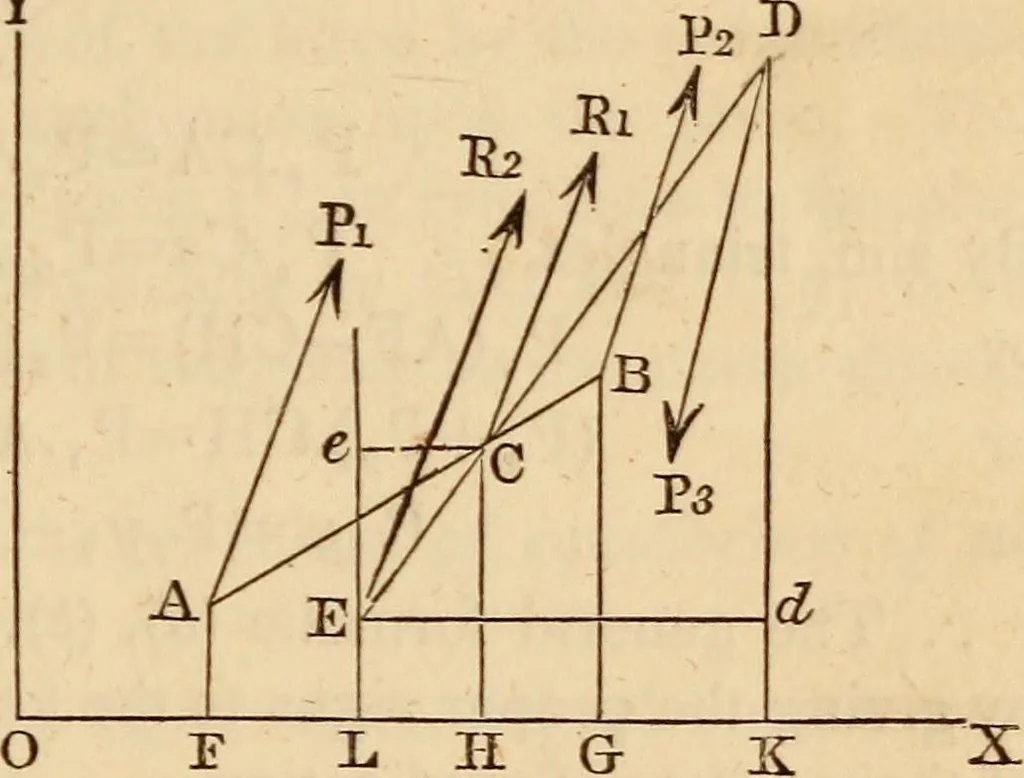
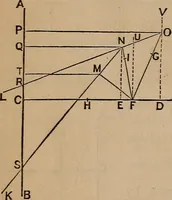
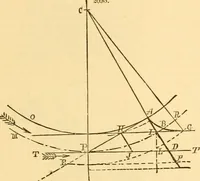
.EL=PTAF+P2.BG+P3DK; or »^-y=P.y.+P.S!it^,- By continuing the same process, we should find, ultimately,R=P1+Pa+P3+...P„ (a), Ry=P1y1+P,ya+P3y,+ ....P-y« (4 By drawing lines from A, C, B, E, D, &c, parallel to OX,we may find, similarly, Ri=P1z1+P2x2+P3a;3+, &c +Ynxn (b). 2°. When some of the… … site to that of Pj and P2,by joining CD and pro-ducing it (Art. 40), in thedirection of the greaterforce, say R,, we haveR2, the second resultant. R2=Ra—P3, and E being its point of application, Rj.EC=P3.ED. Drawing Ce, Ed, parallel to OX, and meeting DKin d and LE produced in e, the triangles ECe,…
Mechanics, Analytic
Internet Archive · Library of Congress · Public Domain Mark 1.0. Free to use for anything.