Newcomb, Simon, 1835-1909 · New York, H. Holt and company · leaf 188
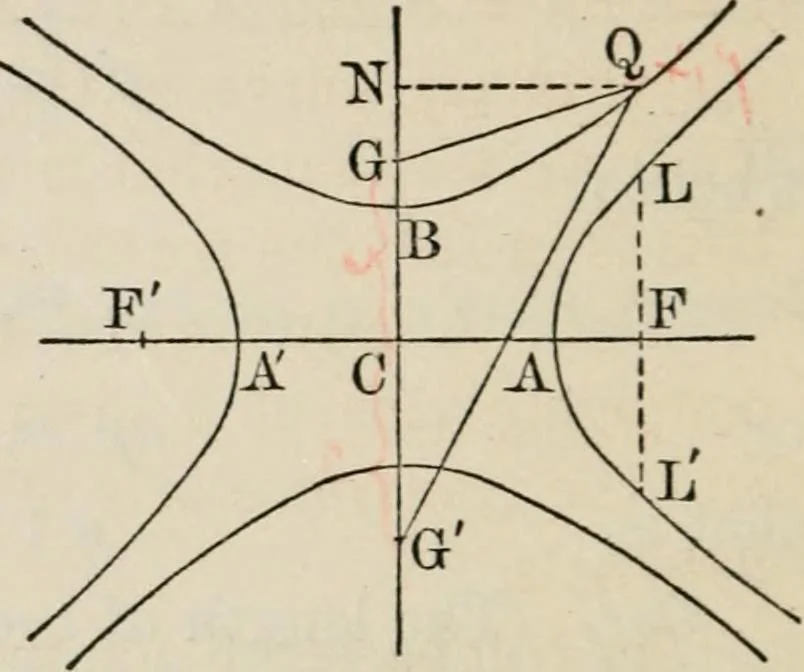
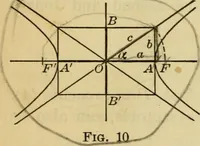
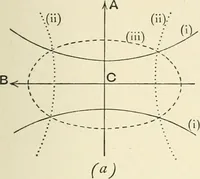
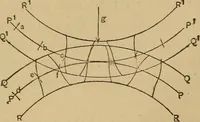
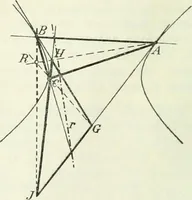
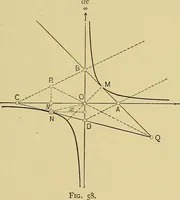
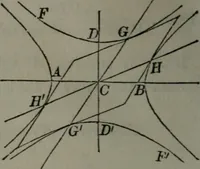
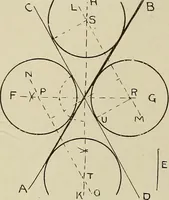
en consider-ing. Let {Xj y) be the co-ordi-nates of any point Q on this newcurve. Then, retaining the sameorigin and axes of reference as before, we shall have CG = CG = c, x = NQ and y = CJST; therefore GQ = (c + yY + q:; GQ = (c-yy^x\ Let the difference between the focal radii GQ, GQ be 2binstead… … or ^ _ .^L - _ 1a b ~ (11) THE HYPERBOLA. 178 which is the equation of the companion-curve or conjugatehyperbola. If in (11) we put x = 0, y=±b=CB or CB, which shows that the conjugate hyperbola has its transverseaxis coinciding in direction and equal in magnitude to theconjugate axis of the…
Geometry, Analytic
Internet Archive · California Digital Library · Public Domain Mark 1.0. Free to use for anything.