Elements of analytical geometry and the differential and integral calculus (1856)
Robinson, Horatio N. (Horatio Nelson), 1806-1867 · Cincinnati : J. Ernst · leaf 111
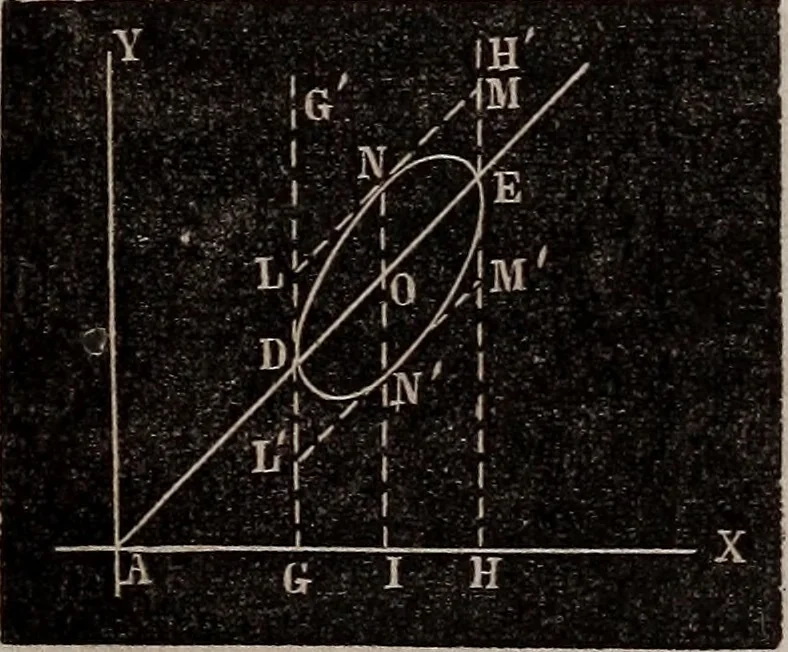
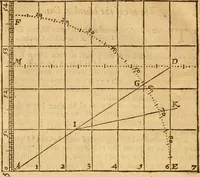
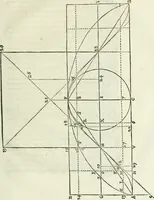
5=—2, (7=2, i)=0, ^=—3, F=2.These values substituted in (1) give y=x^\ ^_4a;2+12a;—8.Or y=x±Lj—x^-\-3x—2, (1) If we put the part under theradical equal to zero we shallhave y=xAnd —ip2-j_3a;—2=0. The first of these represents thestraight line AE, passing throughthe origin A at an angle of 45°with… … CONSTRUCTION OF CURVES. 103 The second part resolved, gives a:=l, or x=2. Tailing x=l,equation (1) becomes y=l±VO.And taking x=2, the same equation becomes The first result corresponds to the point JD, the second to thepoint U, and DU is the diameter of the curve. To find its conjugate diameter…
Geometry, Analytic · Calculus
Internet Archive · Library of Congress · Public Domain Mark 1.0. Free to use for anything.