Elements of analytical geometry and the differential and integral calculus (1856)
Robinson, Horatio N. (Horatio Nelson), 1806-1867 · Cincinnati : J. Ernst · leaf 46
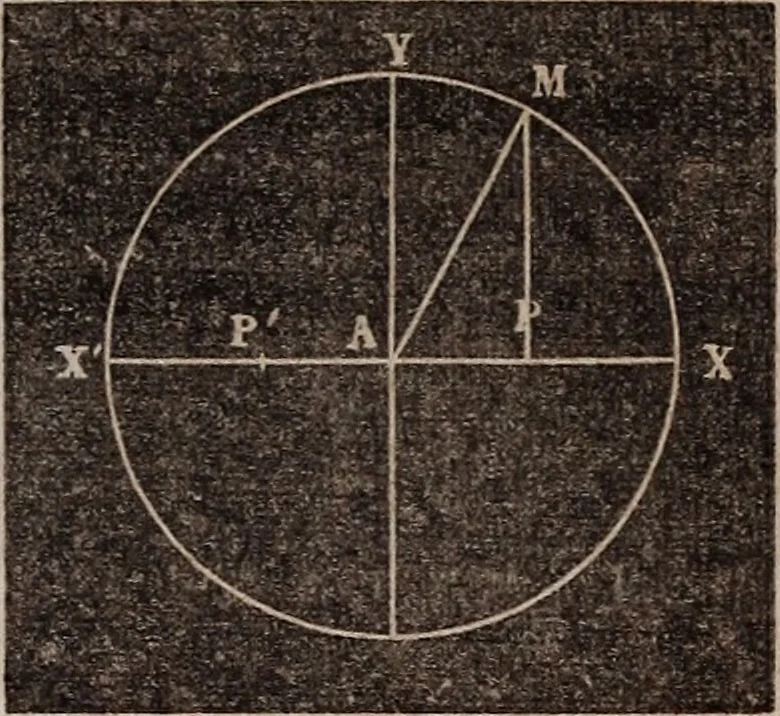
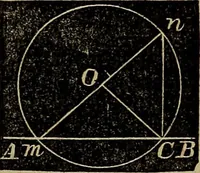
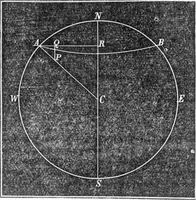
its mostgeneral form is r^-\-2{acos.v-{bsm.v)r+a^+b^=E^. (1) If we make 5=0, it puts the polar point somewhere on theaxis of X, and reduces the equation to r^+ga cos. v.r+a2=i23. (2) Now if we make v=0, thenwill cos. v=l, and the linesrepresented by ±r would refer tothe points X, X, in the circle.… … These results show us that if we describe a circle with the radius Jq-^-lp^, and place F on the axis of X at a distancefrom the center equal to ^p, then PX represents one value ofX, and FX the other. That is, ^=-lP+j9+lP=J^ Or x^=^\p—Jx-\-ip^^=:FX\ and this is the common solution. When p is…
Geometry, Analytic · Calculus
Internet Archive · Library of Congress · Public Domain Mark 1.0. Free to use for anything.