Elements of analytical geometry and the differential and integral calculus (1856)
Robinson, Horatio N. (Horatio Nelson), 1806-1867 · Cincinnati : J. Ernst · leaf 47
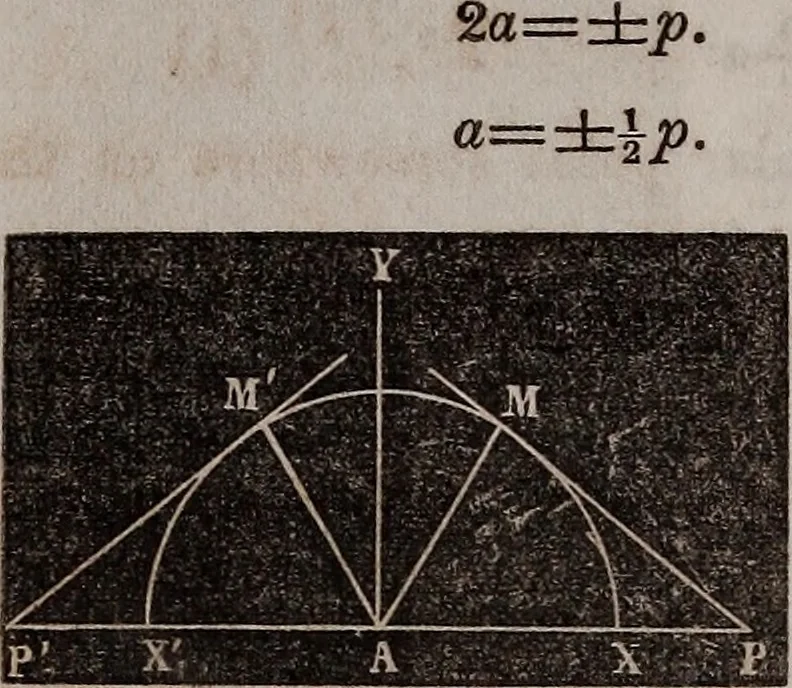
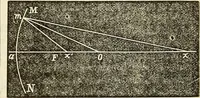
nd place F on the axis of X at a distancefrom the center equal to ^p, then PX represents one value ofX, and FX the other. That is, ^=-lP+j9+lP=J^ Or x^=^\p—Jx-\-ip^^=:FX\ and this is the common solution. When p is negative, the polar point is laid off to the left fromthe center at F\ The operation… … Take AX=R and describe asemicircle. Take AP=\p andAP=—\p. From P and Pdraw the lines PM, and PM totouch the circle. Join AM, AM.Here AP is the hypotenuse ofa right angled triangle. In thefirst case AP was a side. In this figure as in the other, PM=Jq ; but here it is inclinedto the axis of X; in…
Geometry, Analytic · Calculus
Internet Archive · Library of Congress · Public Domain Mark 1.0. Free to use for anything.