Young, Charles A. (Charles Augustus), 1834-1908, Young, Anne Sewell, b. 1871., ed · Boston, New York [etc.] Ginn and Company · leaf 46
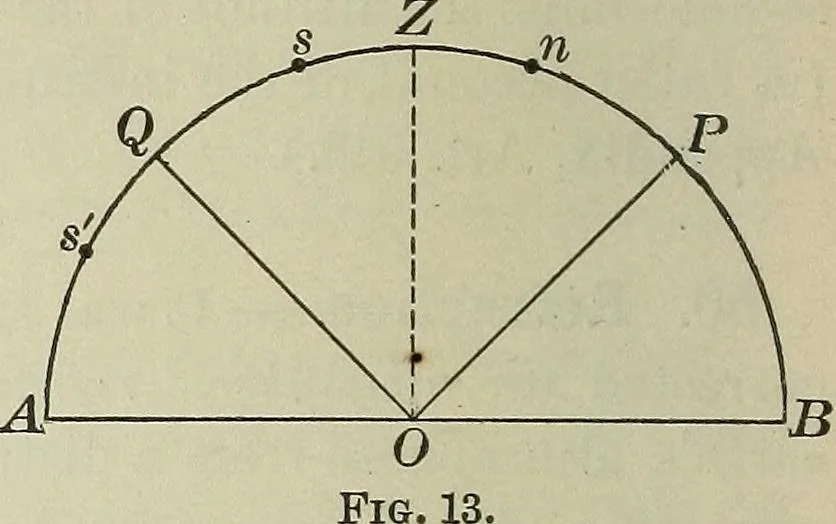
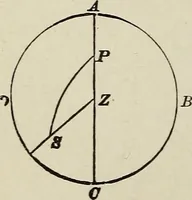
ously the declination of thezenith, or the latitude of the ob-server (Art. 47). Suppose nowthat we observe Zs, the zenithdistance of a star, s, south of thezenith as it crosses the meridian, and that Qs, the declination of the star, is known. Then, evi-dently, QZ equals Qs + sZ\ i.e., the latitude… … § 51] DIFFERENT KINDS OF TIME. 33 If the star were at n, between the zenith and pole, we should have, lati-tude equals the declination minus the zenith distance. If we use the meridian circle in making our observations, we canalways select stars that pass near the zenith where the refraction…
Astronomy · Constellations
Internet Archive · Library of Congress · Public Domain Mark 1.0. Free to use for anything.