Elements of mechanics: treated by means of the differential and integral calculus (1887)
Peck, William G[uy], 1820-1892. [from old catalog] · New York, Chicago, A. S. Barnes & company · leaf 123
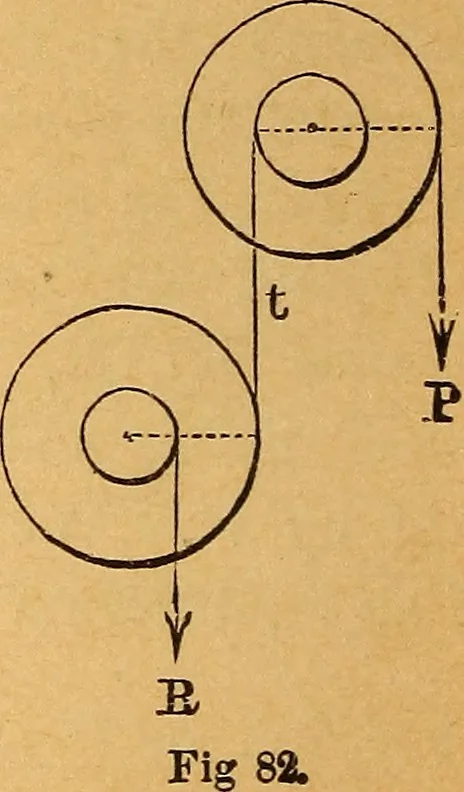
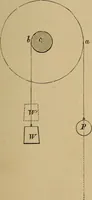
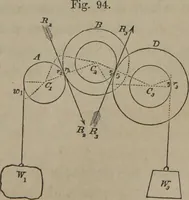
ng great mechanical advantage. Thefigure represents a combination of twowheels and axles. To deduce theconditions of equilibrium, denote thepower by _P, the resistance by i?, theradius of the first wheel by r, that ofthe first axle by r, that of the secondwheel by r, and that of the secondaxle by… … ELEMENTARY MACHINES. 119 Multiplying these equations together, member by member,and reducing, we have, Prr = Prr; or, P : JR : : rr rr . In like manner, were there any number of wheels andaxles in the combination, we might deduce the relation, or, Prrrlv . .P : R : : rVVv ifrW (45.) That is, the…
Mechanics
Internet Archive · Library of Congress · Public Domain Mark 1.0. Free to use for anything.