Elements of mechanism: elucidating the scientific principles of the practical construction of machines, for the use of schools, and students in mechanical engineering, with numerous specimens of modern machines, remarkable for their utility and ingenuity (1852)
Baker, T. (Thomas), d. 1871 · London, J. Weale · leaf 44
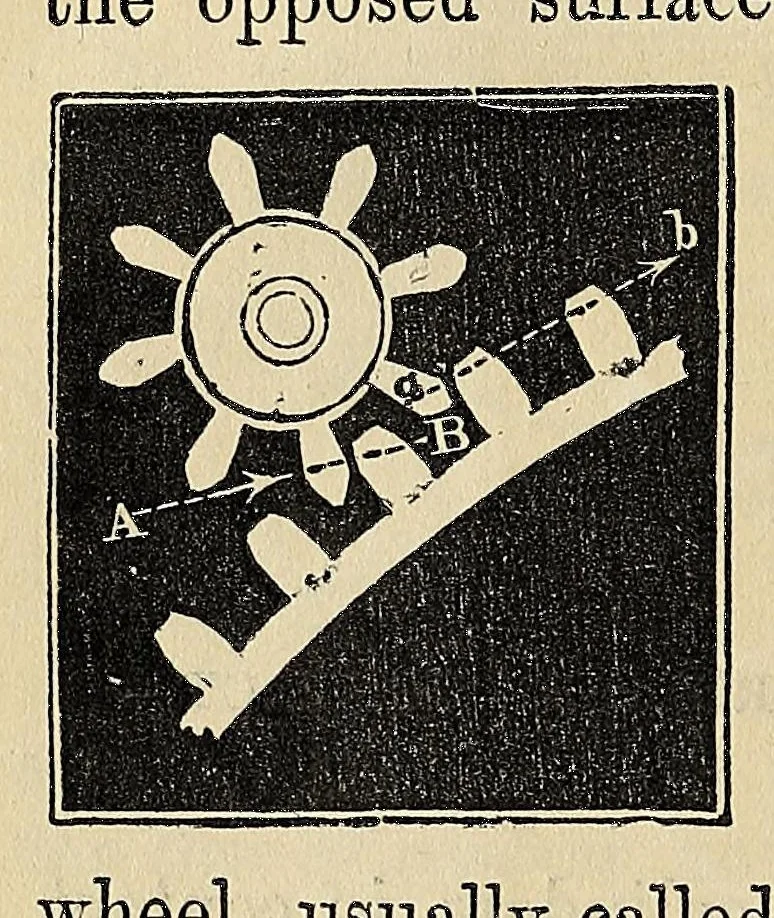
18 WHEEL-WOE, K. 27. There are various methods by which the circum¬ ferences of wheels are made to act upon one another. Sometimes by the mere friction of their surfaces, the friction being increased by cutting the wood so that the grains of the opposed surfaces may run in opposite directions ; in … wheel, usually called a pinion, as a. — Wheels and pinions are usually made of cast-iron, each wheel and its teeth being of one piece. 28. When the teeth of wheels are engaged together, as in the fig., they are said to be in gear , but when disengaged out of gear, 29. The number of times the pinion…
Mechanics · Machinery, Kinematics of · Machine-tools
Internet Archive · Smithsonian Libraries · Public domain (published before 1931). Free to use for anything.
![An illustration from Divina proportione : opera a tutti glingegni perspicaci e curiosi necessaria oue ciascun studioso di philosophia: prospettiua pictura sculptura: architectura: musica: e altre mathematice: suavissima: sotile: e admirabile doctrina consequira: e delecterassi: co[n] varie questione de secretissima scientia (1509)](https://img.insideoutlibrary.com/img/200/ia-divinaproportion00paci-170-393.webp)