The fundamental principles of Old and New World civilizations : a comparative research based on a study of the ancient Mexican religious, sociological and calendrical systems (1901)
Nuttall, Zelia, 1858-1933 · Cambridge, Mass. : Peabody Museum of American Archaeology and Ethnology · leaf 120
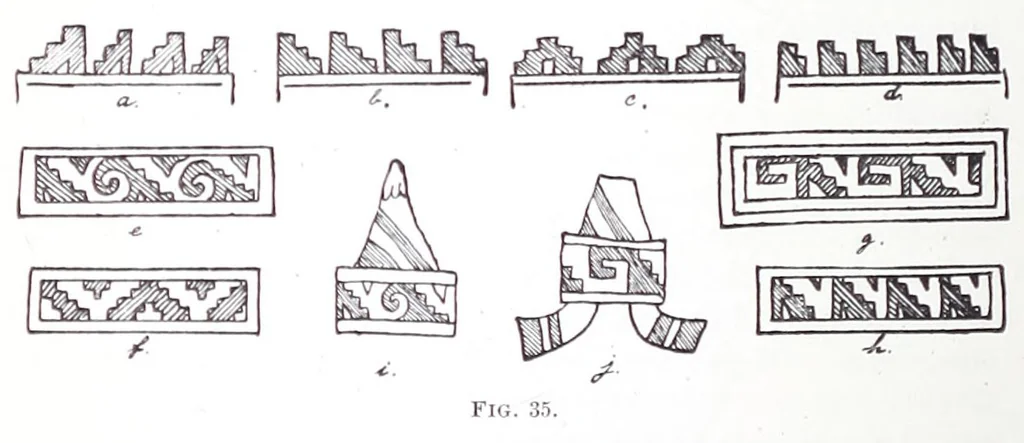
ground inserted in the roof.1 The opposite temple exhibits a roof which rests on a black archi¬ trave and offers a general resemblance to an inverted tau. Itrises Fig. 34. in a tapering form and ends in a cone-shaped ornament. The ex¬ istence and significance of these two forms of temple-roofs… … ceremonial (fig. 35). The first of these ends in a high peak, the extremity of which is represented as capped with snow, in the same conventional manner employed in figuring snow-mountains. An extremely significant feature of this cap is its exhibition of a curved and rounded pattern only ou its…
Civilization -- History · Mayas -- Antiquities · Calendar, Mexican · Mythology · Calendar · Swastikas
Internet Archive · Getty Research Institute · Public domain (published before 1931). Free to use for anything.
![An illustration from Libellus artificiosus omnibus pictoribus, statuarijs, aurifabris, lapidicidis, arcularijs, laminarijs & cultrarijs fabris, sumopere utilis, nec à quae[que] antea uisus, nec prius editus (1539)](https://img.insideoutlibrary.com/img/200/ia-libellusartifici00vogt-32-28.webp)