The Sciopticon manual : explaining lantern projections in general, and the Sciopticon apparatus in particular, including magic lantern attachments, experiments, novelties, colored and photo-transparencies, mechanical movements, etc. (1877)
Marcy, L. J. (Lorenzo J.) · Philadelphia : J.A. Moore · leaf 28
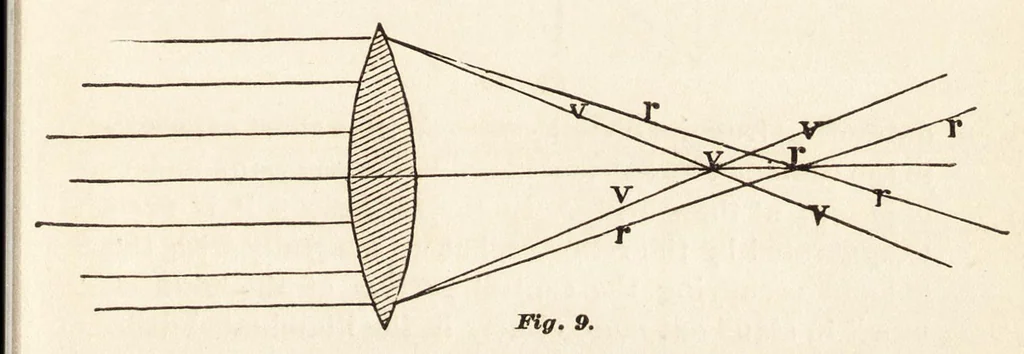
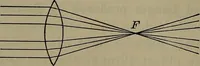
by combining a concave lens of flint-glass with a convex lens of crown- glass, so as to neutralize their contrary dispersions. The concave flint-glass lens / (Fig. 12), which has great dispersive power in proportion to its curves, diverges the violet more than the red, while the convex crown-glass… … perfectly corrected lens by having the sensitive plate a little nearer the lens than the focus of luminous rays on the ground-glass would indicate. Lenses without chro- matic aberration are called achromatic. The term Evplanatic means without wandering, and may apply to lenses corrected of both…
Lantern projection · Slides (Photography)
Internet Archive · Getty Research Institute · Public domain (published before 1931). Free to use for anything.