Ilios; the city and country of the Trojans. The results of researches and discoveries on the site of Troy and throughout the Troad in the years 1871-72-73-78-79, including an autobiography of the author (1880)
Schliemann, Heinrich, 1822-1890, Virchow, Rudolf, 1821-1902, Müller, F. Max (Friedrich Max), 1823-1900, Sayce, A. H. (Archibald Henry), 1845-1933, Mahaffy, J. P. (John Pentland), 1839-1919, Brugsch, Heinrich, 1827-1894, Ascherson, Paul, 1834-1913, Postolakas, Achilles, Burnouf, Emile, 1821-1907, Calvert, Frank, Dufield, Alexander James, 1821-90 · New York: Harper & Bros · leaf 455
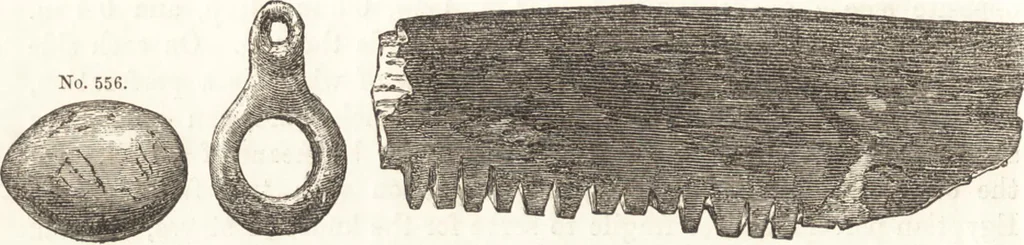
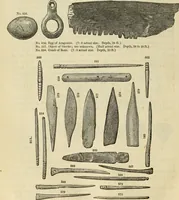
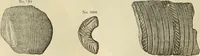
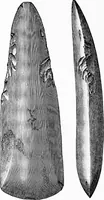
tted to believe tobe of Lydian origin. It is therefore very probable, that all these objectswere imported by the Phoenicians to Troy. No. 556 is a prettily-shaped egg of aragonite. No. 557 representsan object of diorite, of unknown use. There were also found severalunpolished hexagons of crystal,… … No. 556. Egg of Aragonite. (7: 8 actnal size. Depth, 26 ft.) No. 557. Object of Diorite; use unknown. (Half actual size. Depth, 26 to 28ft.) No. 558. Comb of Bone. (7 : 8 actual size. Depth, 23 ft.)
Archaeology
Internet Archive · Getty Research Institute · Public Domain Mark 1.0. Free to use for anything.