An attempt to discriminate the styles of architecture in England : from the Conquest to the Reformation ; with a sketch of the Grecian and Roman orders /by the late Thomas Rickman (1881)
Rickman, Thomas, 1776-1841, Parker, John Henry, 1806-1884, Le Keux, John Henry, 1812-1896, Cattermole, George, 1800-1868, Mackenzie, Frederick, 1787 or 8-1854, Jewitt, Thomas Orlando Sheldon, 1799-1869, Starling, William Francis, Hacker, C., 19th cent, Carter, James, 1798-1855, Wilkinson, W. S, Smith, C. B · London : Parker and Co. · leaf 334
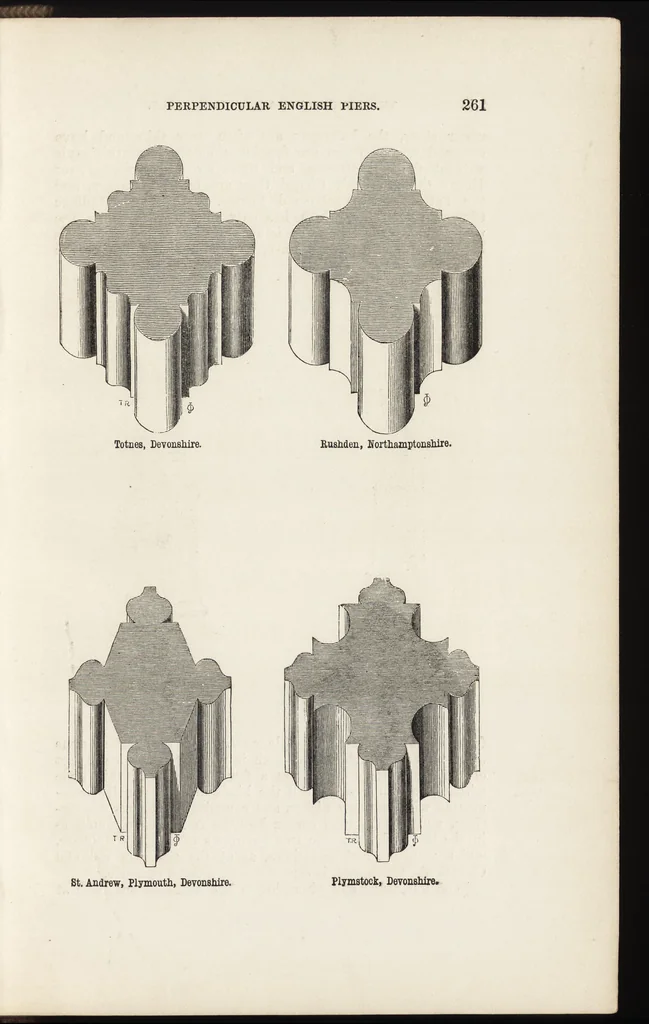
e else; the deepcutting of the earlier styles is quite lost, (excepting the onewide and deep hollow, as at Plymstock,) and the surface of thepier is often worked in a wavy line, forming a sort of shallowogee, as at Totnes.] Perpendicular English Buttresses. These differ very little from those of… … 262 THE PERPENDICULAR ENGLISH STYLE. upper story, the buttresses are often very thin, and havediagonal faces. There are few large buildings of this stylewithout flying buttresses, and these aie often pierced; atHenry the Sevenths Chapel they are of rich tracery, andthe buttresses are octagonal…