A handbook on the teeth of gears, their curves, properties and practical construction (1885)
Grant, George B. (George Barnard), 1849-1917 · [Boston] · leaf 20
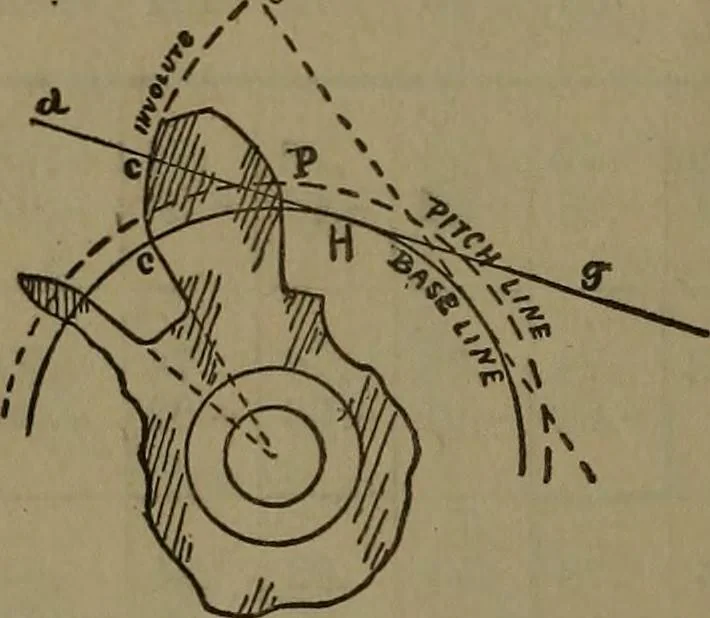
4 .90.03 .94.03 .98.02 1.02.01 1.060 1.110 1.17-.01 1.23-.02 42 37-48 .79.07 .83.06 .86.05 .90.05 .96.04 .98.04 1.03.03 1.08 1.14.03 .02 1.200 1.250 1.37-.01 58 49-72 .83.08 .87.07 .91.07 .96 .06 1.02.06 1.05.05 1.10.04 1.17 1.24.04: .03 1.30.02 1.43 i 1.580 0 ! 97 73-144 .90.09 .93 .08 .97.08… … With the exception of the epicycloid, the only curve in extensive use forthe working face of a gear tooth, is the involute. THE INVOLUTE CURVE. As the rolling circle A of fig. 3 increases in size, it finally, when of infinite diameter, becomes the straight line d g of fig.15, while the epicycloid…
Gearing
Internet Archive · Library of Congress · Public Domain Mark 1.0. Free to use for anything.