History of physical astronomy, from the earliest ages to the middle of the 19th century. Comprehending a detailed account of the establishment of the theory of gravitation by Newton, and its development by his successors; with an exposition of the progress of research on all the other subjects of celestial physics (1852)
Grant, Robert, 1814-1892 · London, R. Baldwin · leaf 618
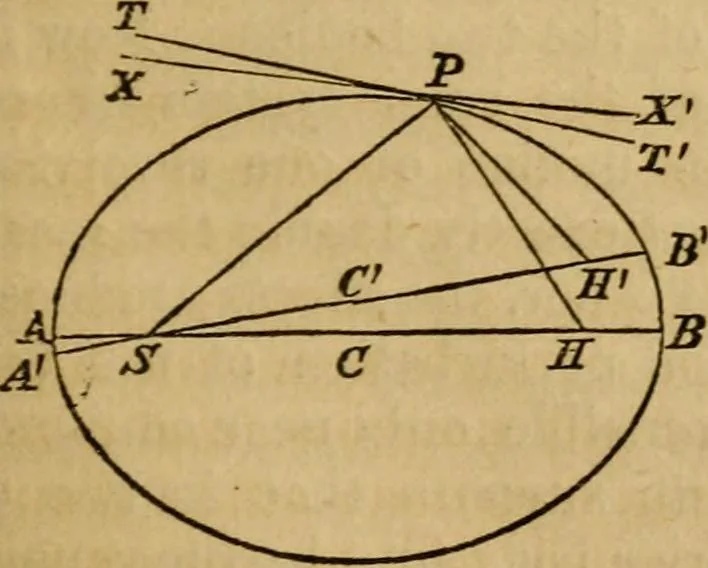
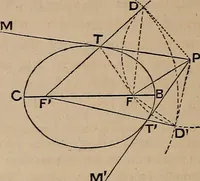
tangential angle. Let it actat p, and let the tangent t t at that point bedeflected in consequence, so as now to occupythe position x x. Draw p h so that theangle h p x shall be equal to s p x, the newvalue of the tangential angle. From p, set offp hequal to ph. Bisect s h in c. Then is s cthe new… … 594 APPENDIX. tangent. Hence the upper focus of the new ellipse must be somewherein the line p h. Again, by another property of the ellipse, the sum of thesame two lines is equal to the major axis. Hence s and h will representthe foci of an ellipse whose tangential angle at p is equal to s p x,…
Astronomy
Internet Archive · Wellesley College Library · Public Domain Mark 1.0. Free to use for anything.