History of physical astronomy, from the earliest ages to the middle of the 19th century. Comprehending a detailed account of the establishment of the theory of gravitation by Newton, and its development by his successors; with an exposition of the progress of research on all the other subjects of celestial physics (1852)
Grant, Robert, 1814-1892 · London, R. Baldwin · leaf 619
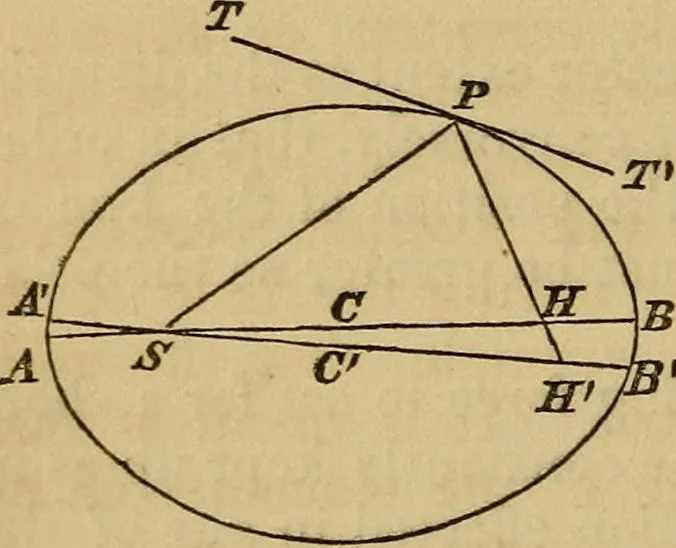
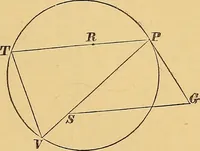
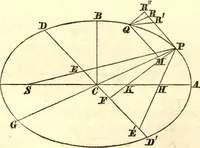
ce, but the majoraxis of the ellipse is increased by its action.Produce p h. so that h h may represent theincrement of the major axis occasioned by thedisturbing force. Join s h, and bisect theline s H in c. Then will s c represent thenew eccentricity of the orbit, and a s h bthe new position of… … II. APPLICATION OF THE FOBEGOING PRINCIPLES TO CERTAIN CASES OF ACTUAL PERTURBATION. (39). Let us suppose two comparatively small bodies to be revolving incircular orbits situate in the same plane, round a large central body s, and letthe mean motion of the interior revolving body be almost exactly…
Astronomy
Internet Archive · Wellesley College Library · Public Domain Mark 1.0. Free to use for anything.