Hydraulic engineering; a practical treatise on the principles of water pressure and flow and their application to the development of water power, including the calculation, design and construction of water wheels, turbines, and other details of hydraulic power plants (1909)
American School (Chicago, Ill.), Black, Adolph, Turneaure, Frederick Eugene, 1866- · Chicago American School of Correspondence · leaf 141
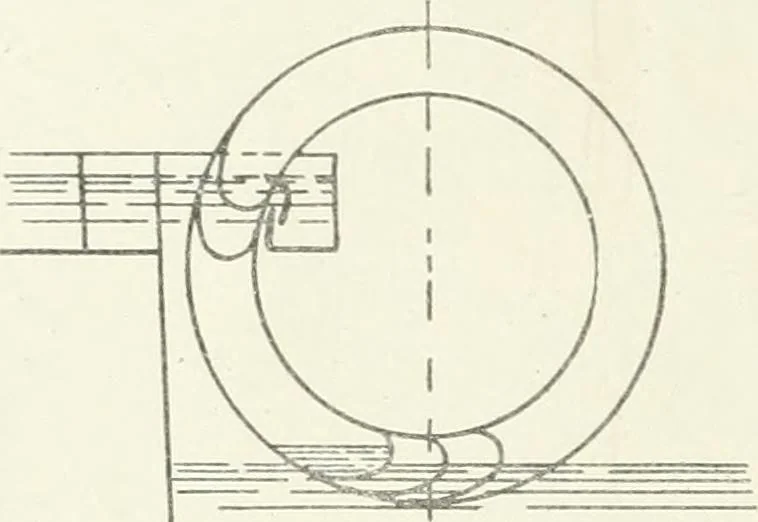
the fall available, the variability of the supply,and the fluctuation in the tail-race level. The number of revolutionsper minute is often less than 1, and rarely exceeds 2\. The penstockspeed is usually 1 to 2 feet per second, and this is about the velocitywith which the water enters the wheel.… … flows. ()n iiccount of its slow sj^eed, it is adaptable only for installa-tions where the machinery runs slowly and opposes uniform resistanceto driving. 68. Millot Wheel. This is a form of breast wheel (Fig. 35) inwhich the breast is not needed. The supply channel divides intotwo branches, which…
![An illustration from [Graphophone patents] (1878)](https://img.insideoutlibrary.com/img/200/ia-graphophonepaten15unit-1043-543.webp)