An introduction to projective geometry and its applications; an analytic and synthetic treatment (1905)
Emch, Arnold, b. 1871 · New York, J. Wiley & sons; London, Chapman & Hall, limited · leaf 147
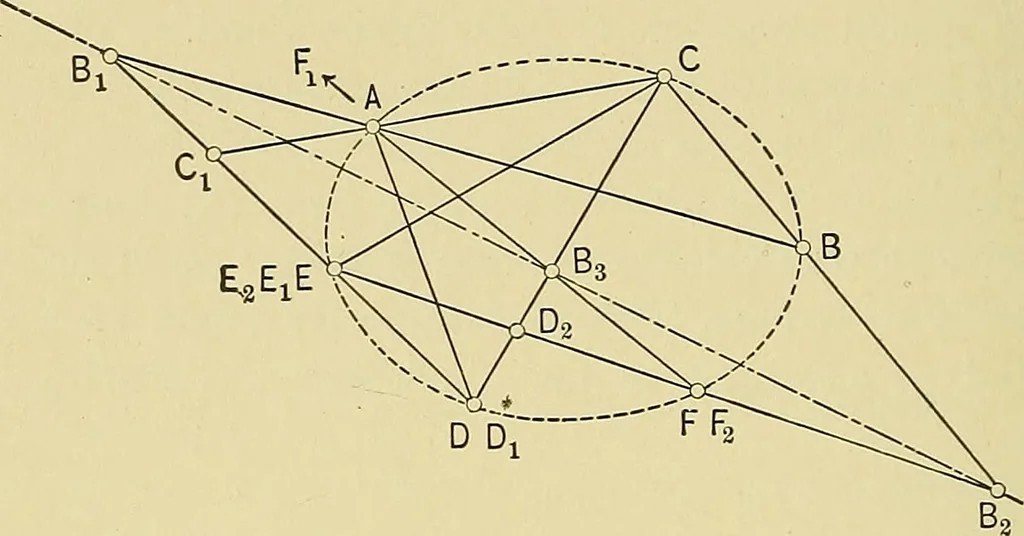
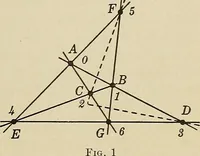
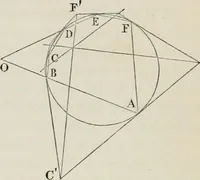
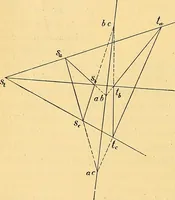
years of age andcalled it Hexagramma Mysticum. It appeared first in Pascals Conic Sections,which was published in 1640. Brianchon (1785-1864) published his theorem in 1806 in the Journal deIEcole Polytechnique, Vol. XIII. 134 PROJECTIVE GEOMETRY. and we may call opposite sides of this hexagon lines… … Fig. 49. were arbitrarily selected, this is generally true, hence PascalsTheorem: In any hexagon which is inscribed in a conic, the three pairsof opposite sides intersect in three collinear points. We shall call such a line of collinearity a Pascal line. By reciprocation. Fig. 50 (§ 37), we obtain…
Geometry, Projective · Geometry, Analytic
Internet Archive · Boston College Libraries · Public Domain Mark 1.0. Free to use for anything.