A London encyclopaedia, or universal dictionary of science, art, literature and practical mechanics : comprising a popular view of the present state of knowledge : illustrated by numerous engravings, a general atlas, and appropriate diagrams (1829)
Curtis, Thomas, fl. 1820 · London : Thomas Tegg · leaf 268
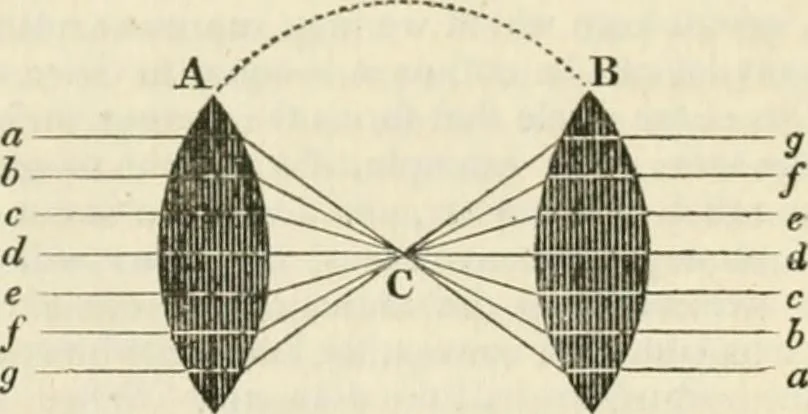
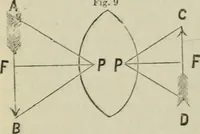
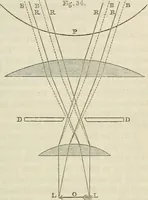
the rays BF and C G, from theextremities of the arrow, in passing through thelens are refracted to the eye in the directions_/A, gA, which makes the arrow to be seen underthe much larger angle D A E, the same as theangle /A g. Therefore the arrow will appear somuch magnified as to extend in length… … cus of both the lenses A and B. The parallelrays a, b, c, d, e,J\ having passed through thelens A, go on converging to its focus C, wherethey unite and thence diverge in a contrary orderto the lens B, and after passino through it theygo on parallel to each other, but in an invertedorder as <i,…
Encyclopedias and dictionaries · Aeronautics
Internet Archive · California Digital Library · Public Domain Mark 1.0. Free to use for anything.