Mechanical movements, powers and devices; a treatise describing mechanical movements and devices used in constructive and operative machinery and the mechanical arts, being practically a mechanical dictionary, commencing with a rudimentary description of the early known mechanical powers and detailing the various motions, appliances and inventions used in the mechanical arts to the present time, including a chapter on straight line movements, by Gardner D. Hiscox (1914)
Hiscox, Gardner Dexter, 1822?-1908 · New York, The Norman W. Henley publishing co. · leaf 29
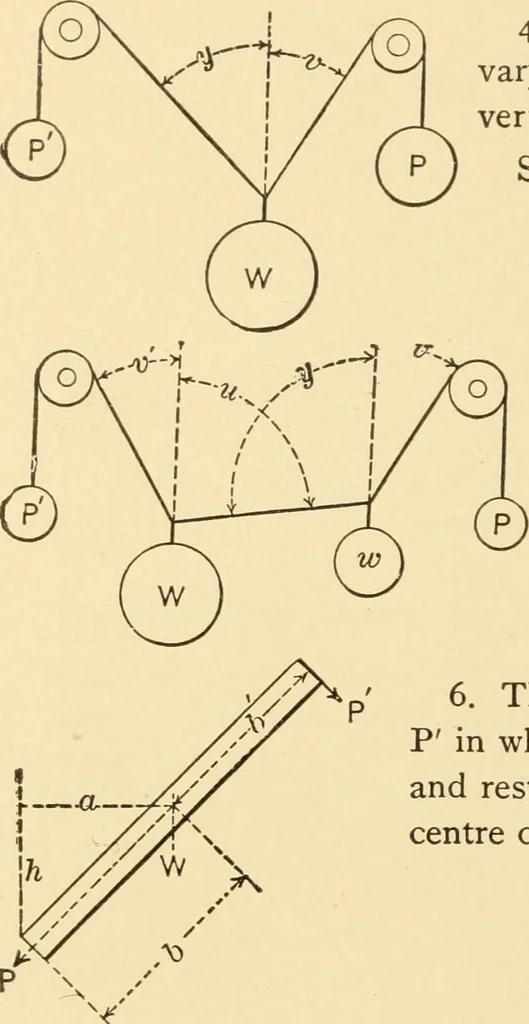
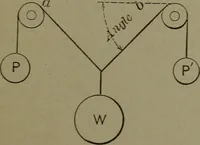
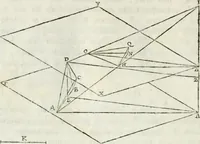
3. THE RESOLUTION OF SUS-PENSION—in which W represents aforce or the weight of gravitation, andP, P the resisting power or equivalentweights. Solution : P and P= half the weight Sine of angle of depression a or 6when the angles are equal. z8 THE MECHANICAL POWERS. … 4. For unequal angles the forc^vary as the sines of the angles from thevertical, respectively. Solution : P = W X sine^ Sine (y-^v) P = W X sine v Sine (y-\-7j) 5. In a combination of forcesthe resolution involves the sines ofthe varying angles. T = w X siney P= W X sinew*Sine(j4-^) Sine(«-j-z/) 6.…
Mechanical movements
Internet Archive · Library of Congress · Public Domain Mark 1.0. Free to use for anything.