Mechanical movements, powers and devices; a treatise describing mechanical movements and devices used in constructive and operative machinery and the mechanical arts, being practically a mechanical dictionary, commencing with a rudimentary description of the early known mechanical powers and detailing the various motions, appliances and inventions used in the mechanical arts to the present time, including a chapter on straight line movements, by Gardner D. Hiscox (1914)
Hiscox, Gardner Dexter, 1822?-1908 · New York, The Norman W. Henley publishing co. · leaf 395
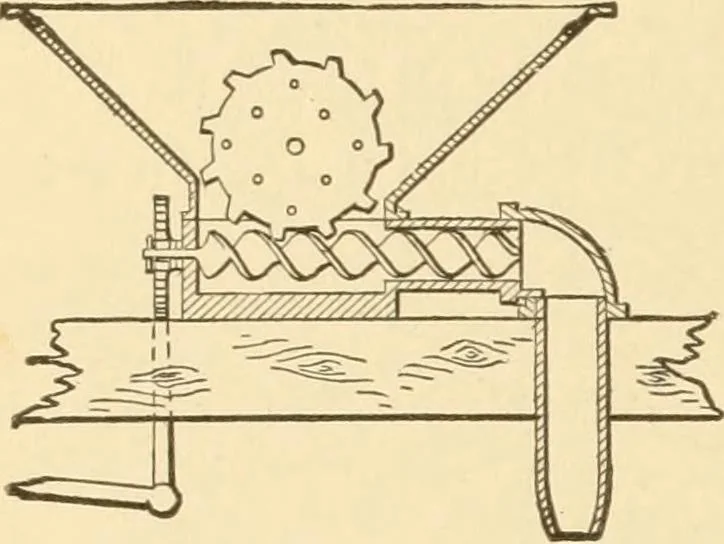
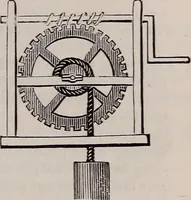
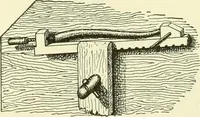
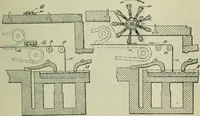
ed up to the crank. Thesaw is fed by a screw moving the gear framedowm on the rail. 1589. PROUTY-NOBLE AUTO-MATIC, OR SELF-WINDINGBRAKE.—The central chain spool 3■^^^ runs loose on the car axle and betweentwo friction flanges, one of which isfast to the axle and the other slideson a feather. The… … 1590, STREET-CAR SAND BOX,— The operation of the lever, pawl, andrachet wheel turns the twisted carrier andat the same time revolves the toothed feedwheel.
Mechanical movements
Internet Archive · Library of Congress · Public Domain Mark 1.0. Free to use for anything.