On some geometric properties and applications of conformal rational transformations in a plane (1912)
Renich, Mary Emma · leaf 40
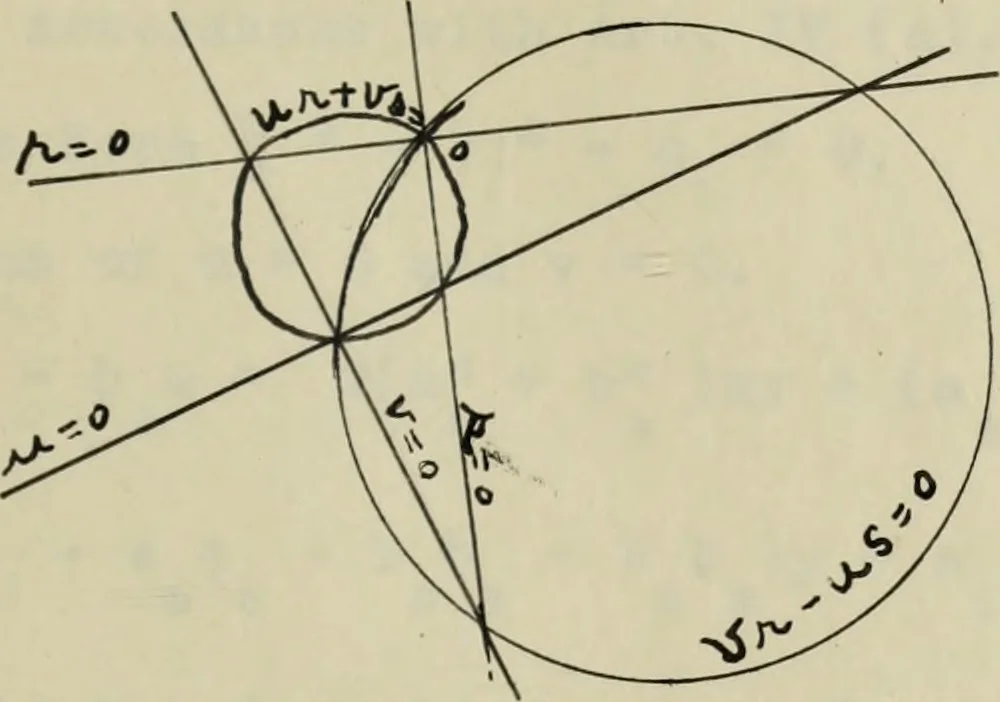
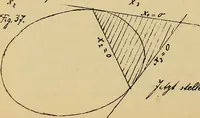
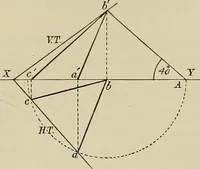
the equations of circles. Since each is of the second degree they have four common solutions Two of these solutions are tne intersections of u s 0 with v = 0 and r - 0 with s = 0, the other two are the circular points at infinity. Fig. VI represents these lines and circles, u = 0 isperpendicular to… … Pig. VI Invariant points. - If the point z is to he trans-formed into itself, we must have z = a.2 or \2? + Sz. - ax. I z +0 -/3= o. This equation is a quadratic and has, therefore, two roots. Thetwo points zi and zg must remain unchanged hy the transformation,since each is transformed into…