Photographic optics and colour photography : including the camera, kinematograph, optical lantern, and the theory and practice of image formation (1909)
Johnson, G. Lindsay (George Lindsay), 1853-1943 · New York : D. Van Nostrand Co. · leaf 190
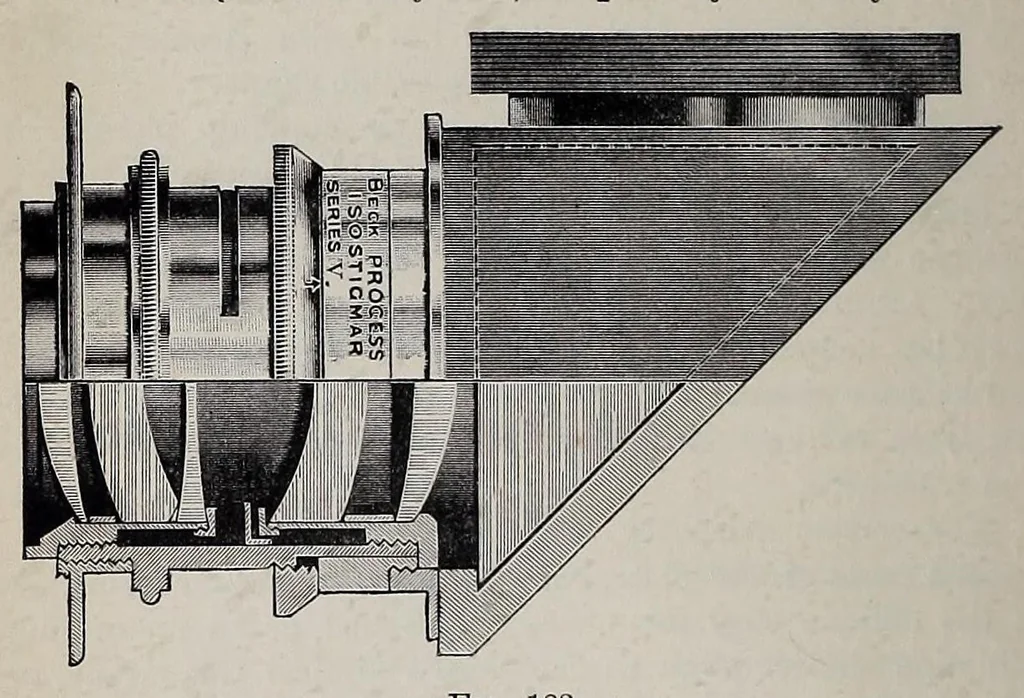
2 PHOTOGRAPHIC OPTICS stop requiring double the exposure of the one before it, P/4 being usually taken as unity. Thus — P F FPP F PPPPP 2 2,83 4 5,6 8 11,3 16 22 32 45 64 Time a \ 1 2 4 8 16 32 64 128 256 There are other methods in use in which stops are numbered according to the relative exposures… … Fig. 123. graphic Society. In this system P/4 is taken as the unit and called 1. The other stops are so numbered that the numbers indicate the relative exposures required as compared with No. 1. Thus F/5,6 = 2, P/7 = 3, P/8 = 4, requiring 2, 3, and 4 times the exposure of P/4. It is the same as the…
Photographic optics · Color photography
Internet Archive · Getty Research Institute · Public domain (published before 1931). Free to use for anything.
![An illustration from [Graphophone patents] (1878)](https://img.insideoutlibrary.com/img/200/ia-graphophonepaten17unit-408-0.webp)