Plane and solid analytic geometry; an elementary textbook (1901)
Ashton, Charles H. (Charles Hamilton), 1866- · New York, C. Scribner's sons · leaf 36
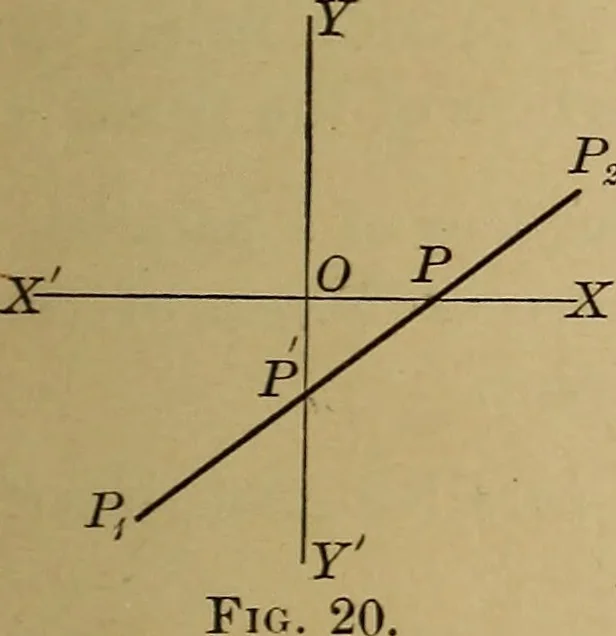
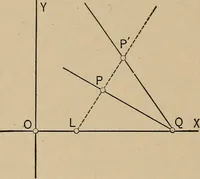
oints A, B, C, and D are said to form aharmonic range. If parallel lines are drawn through the points A, B, (7,and D of a harmonic range,their intersections A\ B, C\and D, with any transversal,will also be a harmonic range. For, from plane geometry, ABBC AB ~~BCr Hence and AD ADf A B C A[^~~— P/^… … _ m\X<2. + m2xim\ + m2 _2.5 + l(-3)_71 + 2 3 . fflij/a + ni2yi _ 2 . 2 + 1 (- 4) _ mi + m2 1 + 2 and the point of trisection is (f, 0).But if we wish to find P, m\ = 1, m2 = 2, 1 5 + 2(- 3)_ 1 1 1+2• 2 + 2(- ■4)_ 3 2 1 + 2 and the other point of trisection is (— i, — 2). 18 ANALYTIC GEOMETRY…
Geometry, Analytic
Internet Archive · Library of Congress · Public Domain Mark 1.0. Free to use for anything.