The practical astronomer : comprising illustrations of light and colours, practical descriptions of all kinds of telescopes, the use of the equatorial-transit, circular, and other astronomical instruments, a particular account of the Earl of Rosse's large telescopes, and other topics connected with astronomy (1845)
Dick, Thomas, 1774-1857 · London : Seeley, Burnside, and Seeley · leaf 266
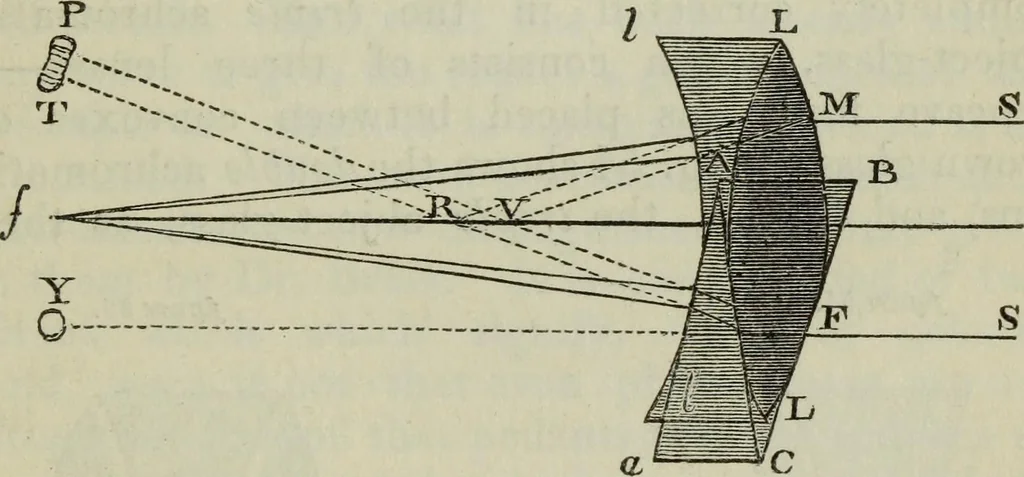
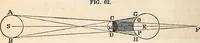
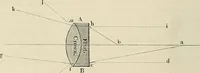
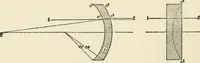
t will be to that producedby the crown glass, as 3 to 2 nearly. Now, ifwe make the focal lengths of the lenses in thisproportion, that is, as 3 to 2, the coloured spec-trum produced by each will be equal. But if theflint lens be concave, and the crown convex—when placed in contact—they will… … represent a convex lens of crown glass, and // aconcave lens of flint glass. A ray of the sun S,falls at F on the convex lens which will refract itexactly as the prism ABC, whose faces touch thetwo surfaces of the lens at the points where theray enters and quits it. The solar ray, SF, thusrefracted…
Astronomy · Astronomical instruments · Telescopes
Internet Archive · Getty Research Institute · Public Domain Mark 1.0. Free to use for anything.