The principles underlying radio communication (1922)
United States. National Bureau of Standards, Ould, Richard Sheldon, 1889-, United States. Army. Signal Corps · Washington, Govt. Print. Off. · leaf 284
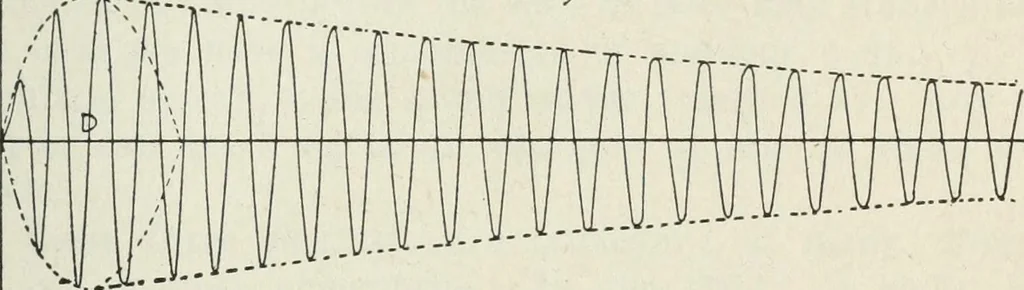
taining an impulse excitation of the secon-dary is to insert so much resistance in the primary that itscurrent falls away aperiodically (see Sec. 116, p. 257). This has.however, the disadvantage that considerable energy is lost inthe primary due to the heating of the rather large resistanceof the… … A more satisfactory arrangement is the quenched gap. Bydividing the spark gap in the primary into a number of short,gaps in series, the cooling effect of the relatively large amountof metal is available for carrying away the heat of the sparkdischarge. This is found to be sufficient, in the case of…
Telegraph, Wireless · Radio
Internet Archive · Public Domain Mark 1.0. Free to use for anything.