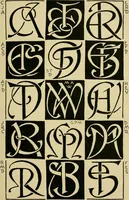
A Roman alphabet and how to use it; a conventional Roman alphabet with full directions for its use in the lettering problems required in public, normal, art, and technical schools, and for the lettering problems which arise in the practice of architects, commercial illustrators, show-card writers and sign painters (1917)
Frederick, Frank Forrest, 1866-1942 · Trenton, N.J., F.F. Frederick · leaf 20
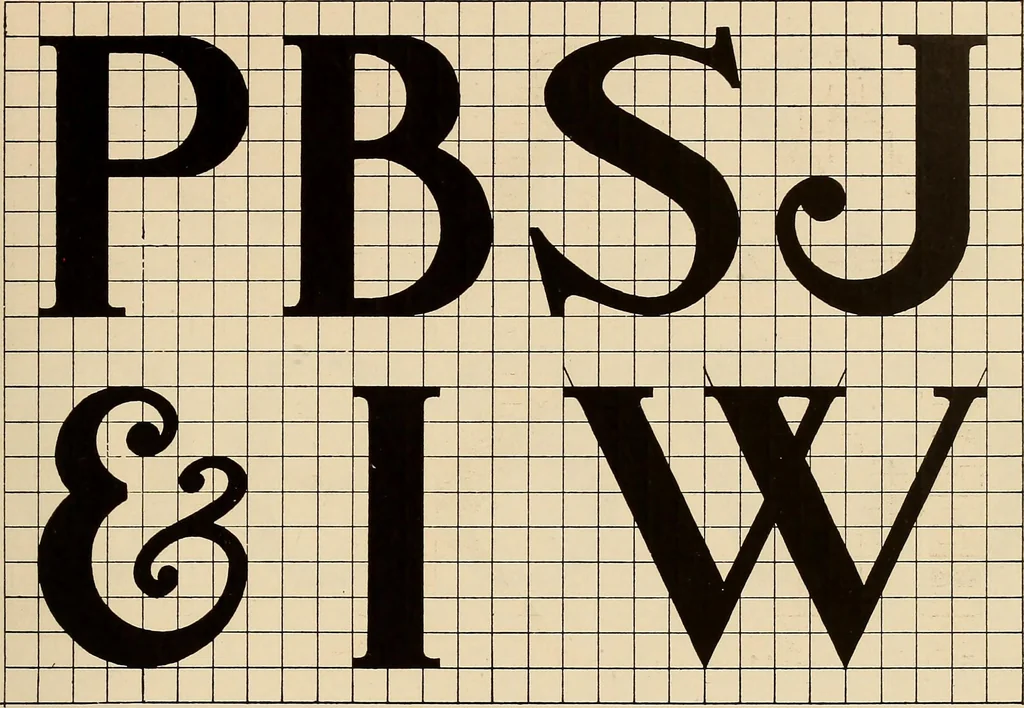
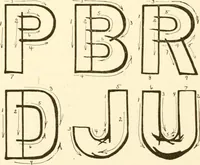
om left to right, except in Z, belight lines. 5. That all curved lines be light at. or near, the top and bottom andhea^y at the sides of the letters. Centuries of use of the Roman alphabet by artists have shown thatcertain letters must be drawn wider than others to look right, and thatseveral… … No. 4. See page 9. certain letters and always draw each letter the same way until he is ex-perienced enough to vary them intelligently. Comparing the Roman alphabets, it is found that, for all practicalpurposes, the twenty-six letters can be divided into six groups of widthsas follows: 1. 0^ Q^ G^…
Lettering
Internet Archive · Library of Congress · Public Domain Mark 1.0. Free to use for anything.


![An illustration from Vnderweysung der Messung : mit dem Zirkel vn[d] Richtscheyt in Linien, Ebnen vnnd gantzen Corporen (1525)](https://img.insideoutlibrary.com/img/200/ia-vnderweysungderm00drer-116-226.webp)
![An illustration from Divina proportione : opera a tutti glingegni perspicaci e curiosi necessaria oue ciascun studioso di philosophia: prospettiua pictura sculptura: architectura: musica: e altre mathematice: suavissima: sotile: e admirabile doctrina consequira: e delecterassi: co[n] varie questione de secretissima scientia (1509)](https://img.insideoutlibrary.com/img/200/ia-divinaproportion00paci-168-392.webp)

![An illustration from Pars I. des berühmten italiänische[n] Ritters Caesaris Ripae, allerley Künsten und Wissenschafften dienlicher Sinnbildern und Gedancken : welchen jedesmahlen eine hierzu taugliche Historia oder Gleichnis beÿgefüget (1758)](https://img.insideoutlibrary.com/img/200/ia-parsidesberuhmte00ripa-354-176.webp)