A text-book of general astronomy : for colleges and scientific schools (1888)
Young, Charles A. (Charles Augustus), 1834-1908 · Boston ; London : Ginn & Company · leaf 31
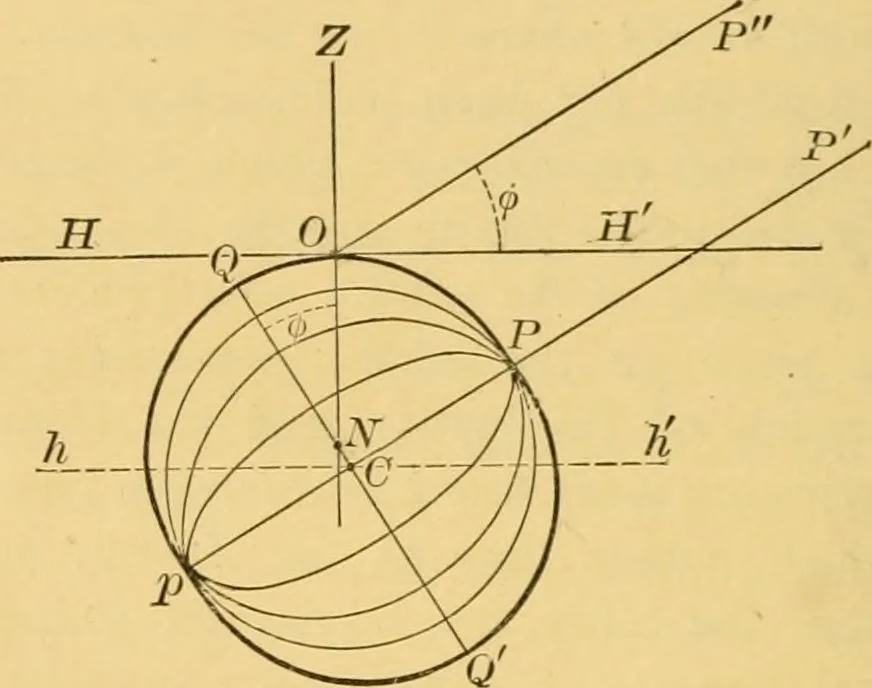
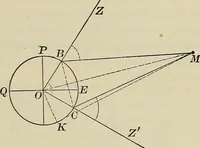
phies disregards the slightdifference.] Now the angle IIOP is equal to ONQ, because their sides aremutually perpendicular; and it is also the altitude of the pole, be-cause the line IIII is horizontal at 0, and OP is parallel to PP\ theearths axis, and therefore points to the celestial pole. This… … Fig. 6. —Relation of Latitude to the Elevation of the Pole. 31. The Right Sphere. — If the observer is situated at theearths equator, i.e., in latitude zero (<f> = o), the pole will be in thehorizon, and the equator will pass vertically overhead through thezenith. The stars will rise and set…
Astronomy
Internet Archive · Wellesley College Library · Public Domain Mark 1.0. Free to use for anything.