The textile industries : a practical guide to fibres, yarns & fabrics in every branch of textile manufacture, including preparation of fibres, spinning, doubling, designing, weaving, bleaching, printing, dyeing and finishing (1910)
Murphy, William S · London : The Gresham Publishing Company · leaf 163
cop shaper and copping rail. The arrangement ofthose levers is, as nearly as possible, the form of the cop at each time ofthe carriage traverse. As the carriage passes along the incline of thecopping rail, it is lifted or depressed, and the shaper gives finer detailto the action. All the cops are… … As a rule the output of the scribblers determines the spindleage on themules following them. Factory conditions also govern the sizes of theframes; for every additional spindle adds on at least 2 in. to the lengthof the frame, and space in factories is very valuable. On the otherhand, it is better…
Textile industry · Textile fabrics
Internet Archive · UMass Dartmouth, Claire T. Carney Library · Public Domain Mark 1.0. Free to use for anything.
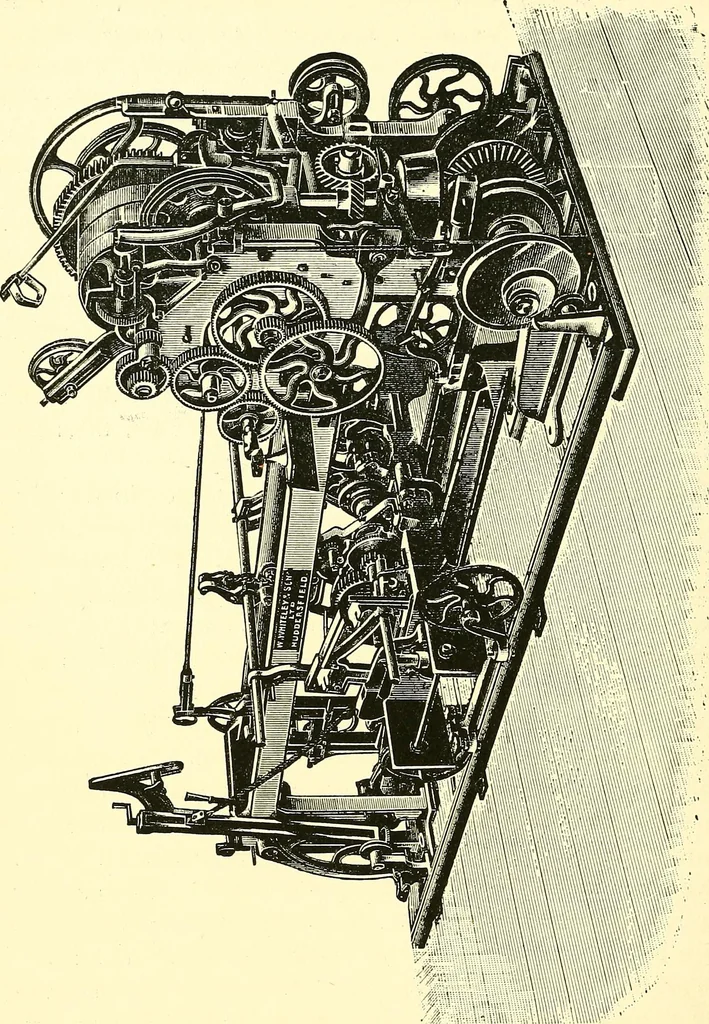
![An illustration from The Mason Machine Works, Taunton, Massachusetts, U.S.A., inventors and builders of cotton machinery : Founded 1842 ; Incorporated 1873 ; [Catalogue] (1898)](https://img.insideoutlibrary.com/img/200/ia-masonmachinework00maso-159-49.webp)