A treatise on surveying and navigation: uniting the theoretical, the practical, and the educational features of these subjects (1852)
Robinson, Horatio N[elson], 1806-1867. [from old catalog] · Cincinnati, J. Ernst · leaf 209
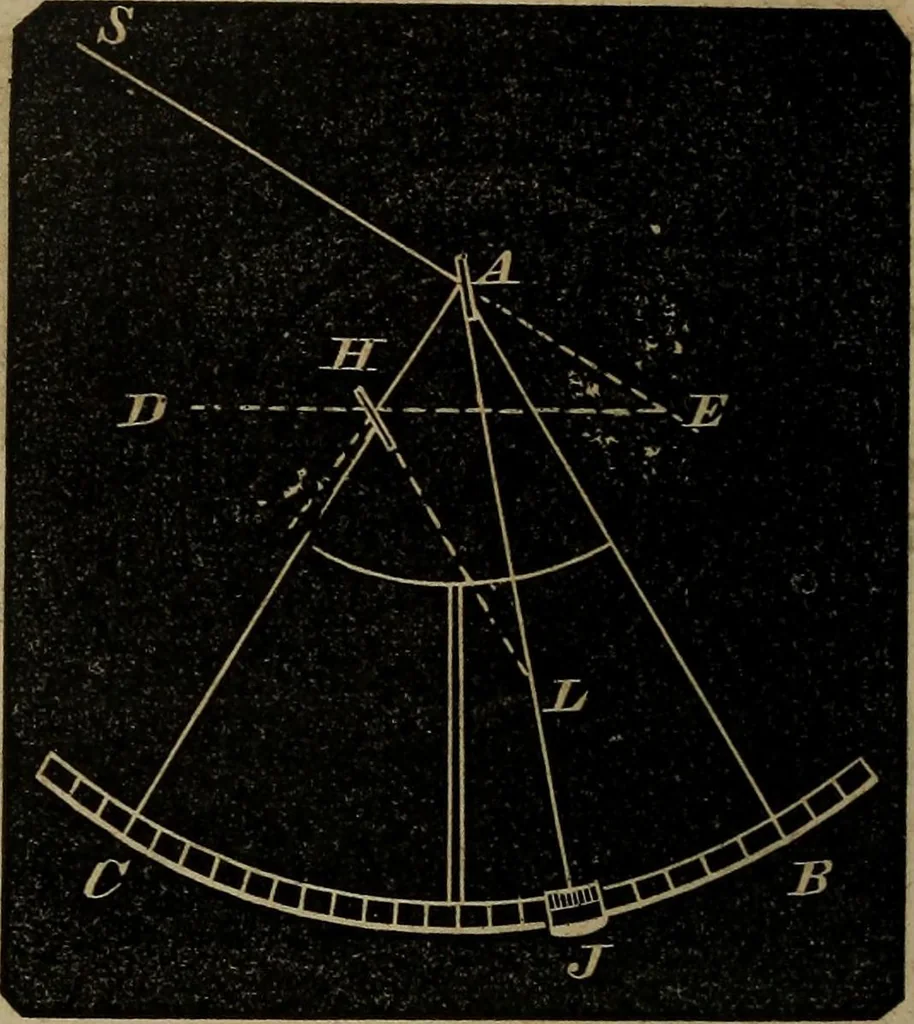
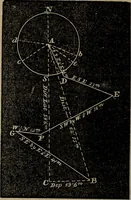
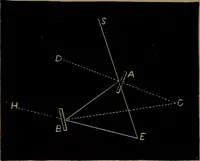
E4-y-|-C+z=180o (2) Subtracting (2) from (1) gives us A—E+y—z=0 (3) Whence, A=E-\-(x—y) (4) But because x is the exterior angle of the triangle ECB x=E-\-y (see Elementry Geometry.)Or, (x—y)=E This value of (x—y) substituted in (4) gives A=2E, or E=-£ Q. E. D. Another Demonstration. — The angle x… … We are now prepared toshow the construction ofthe sextant and quadrant. The instrument repre-sented by the annexed cutis a quadrant or a sextant,according as the arc con-tains 90° or 120°, but eachactual degree of arc isgraduated to 2°, and thespace that covers 90° isreally but 45°, and so on. The…
Surveying · Navigation
Internet Archive · Library of Congress · Public Domain Mark 1.0. Free to use for anything.