The wonders of the heavens, being a popular view of astronomy, including a full illustration of the mechanism of the heavens; embracing the sun, moon, and stars, with descriptions of the planets, comets, fixed stars, double stars, the constellations, the galaxy, or milky-way, the zodiacal light, aurora borealis, or norhtern lights, meteors, clouds, falling stars, aërolites, &c (1837)
Bradford, Duncan. [from old catalog] · Boston, American stationers company · leaf 109
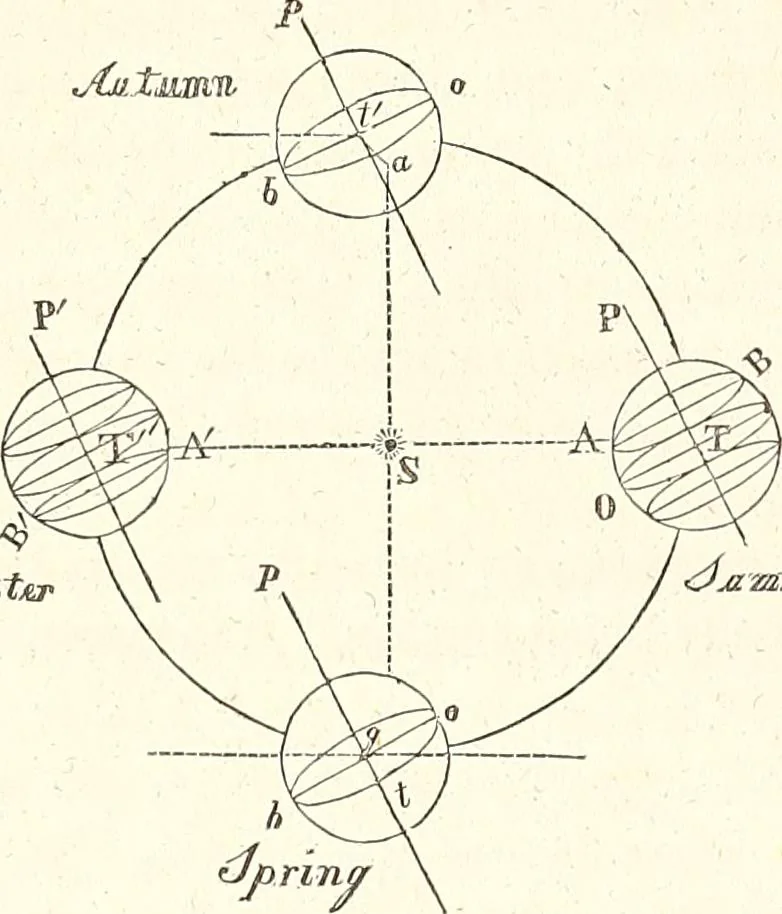
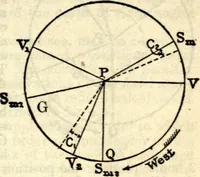
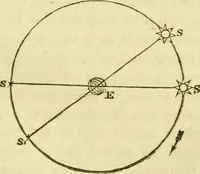
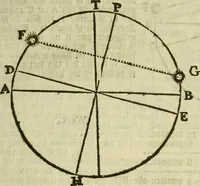
the lengths would vary with the velocity of the mo-tion, and would exactly represent what is called,in regard to the earths annual motion, the radiusvector. The orbit, which is also called theecliptic, we shall see hereafter is not a circle ; andwhile the diurnal rotation is uniform, the rapidityof… … djarina and its orbit at every point of that curve. Let Tbe our globe; the radius vector meets the surfaceat A. The plane A B, perpendicular to the axisP T, marks out the circle A B, each point ofwhich comes in turn to A by reason of the diurnalrotation. The sun being supposed fixed at S,…
Astronomy
Internet Archive · Library of Congress · Public Domain Mark 1.0. Free to use for anything.