The wonders of the heavens, being a popular view of astronomy, including a full illustration of the mechanism of the heavens; embracing the sun, moon, and stars, with descriptions of the planets, comets, fixed stars, double stars, the constellations, the galaxy, or milky-way, the zodiacal light, aurora borealis, or norhtern lights, meteors, clouds, falling stars, aërolites, &c (1837)
Bradford, Duncan. [from old catalog] · Boston, American stationers company · leaf 112
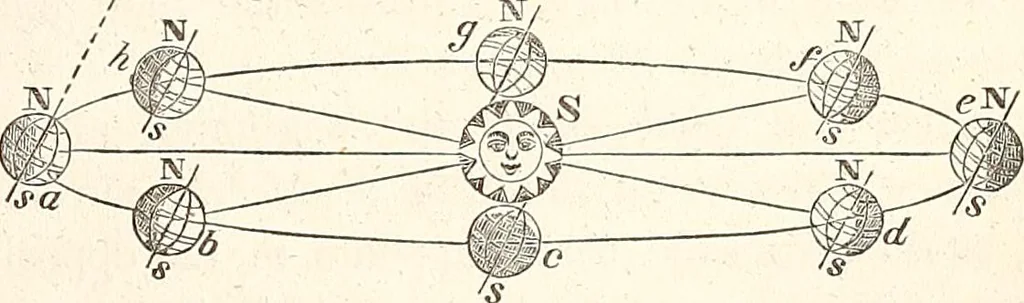
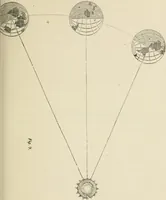
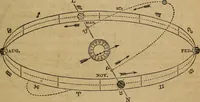
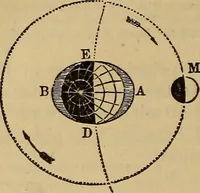
rth we are upon, we consider it ashaving no inclination; and yet, if we travel ninetydegrees from that place, we shall then have ahorizon perpendicular to the former; but it willstill be level to us. Let us now illustrate the annual course of theearth round the sun; its axis inclining… … Let a, b, c, d, e,f, g, h be the earth in eight dif-ferent parts of its orbit, equidistant from oneanother; N 5 its axis, N the north pole, s the south 78 WONDERS OF THE HEAVENS. pole, and S the sun, nearly in the centre of theearths orbit. As the earth goes round the sunaccording to the order of…
Astronomy
Internet Archive · Library of Congress · Public Domain Mark 1.0. Free to use for anything.