The wonders of the heavens, being a popular view of astronomy, including a full illustration of the mechanism of the heavens; embracing the sun, moon, and stars, with descriptions of the planets, comets, fixed stars, double stars, the constellations, the galaxy, or milky-way, the zodiacal light, aurora borealis, or norhtern lights, meteors, clouds, falling stars, aërolites, &c (1837)
Bradford, Duncan. [from old catalog] · Boston, American stationers company · leaf 115
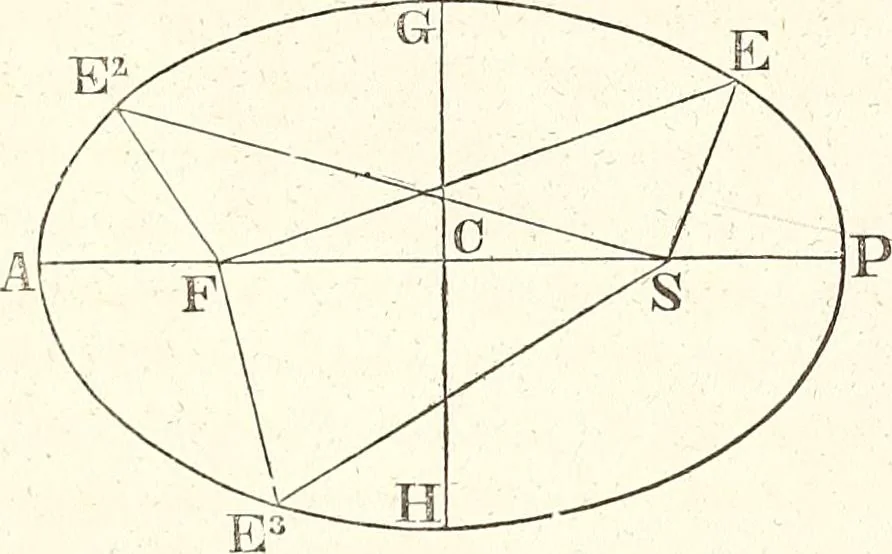
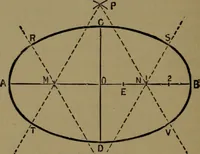
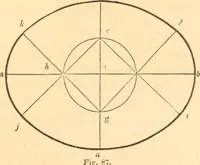
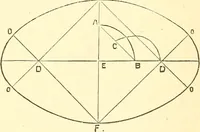
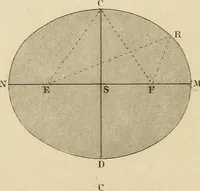
gth. The diame-ter drawn at right angles to the greater axis iscalled the conjugate axis. This curve may be de-scribed by means of two points lying in the greateraxis and equally distant from the central point;they are so situated that the sum of the lines drawnfrom each of them to any point of the… … the lines S E, F E, drawn to any point of the curve,is the same, and equal to the transverse A P. Ap-plying this to the earth, S is the sun in one of thefoci, E the earth passing from west to east alongthrough G to A. The method of drawing theellipse is very simple. Take a thread equal in length to…
Astronomy
Internet Archive · Library of Congress · Public Domain Mark 1.0. Free to use for anything.