The wonders of the heavens, being a popular view of astronomy, including a full illustration of the mechanism of the heavens; embracing the sun, moon, and stars, with descriptions of the planets, comets, fixed stars, double stars, the constellations, the galaxy, or milky-way, the zodiacal light, aurora borealis, or norhtern lights, meteors, clouds, falling stars, aërolites, &c (1837)
Bradford, Duncan. [from old catalog] · Boston, American stationers company · leaf 122
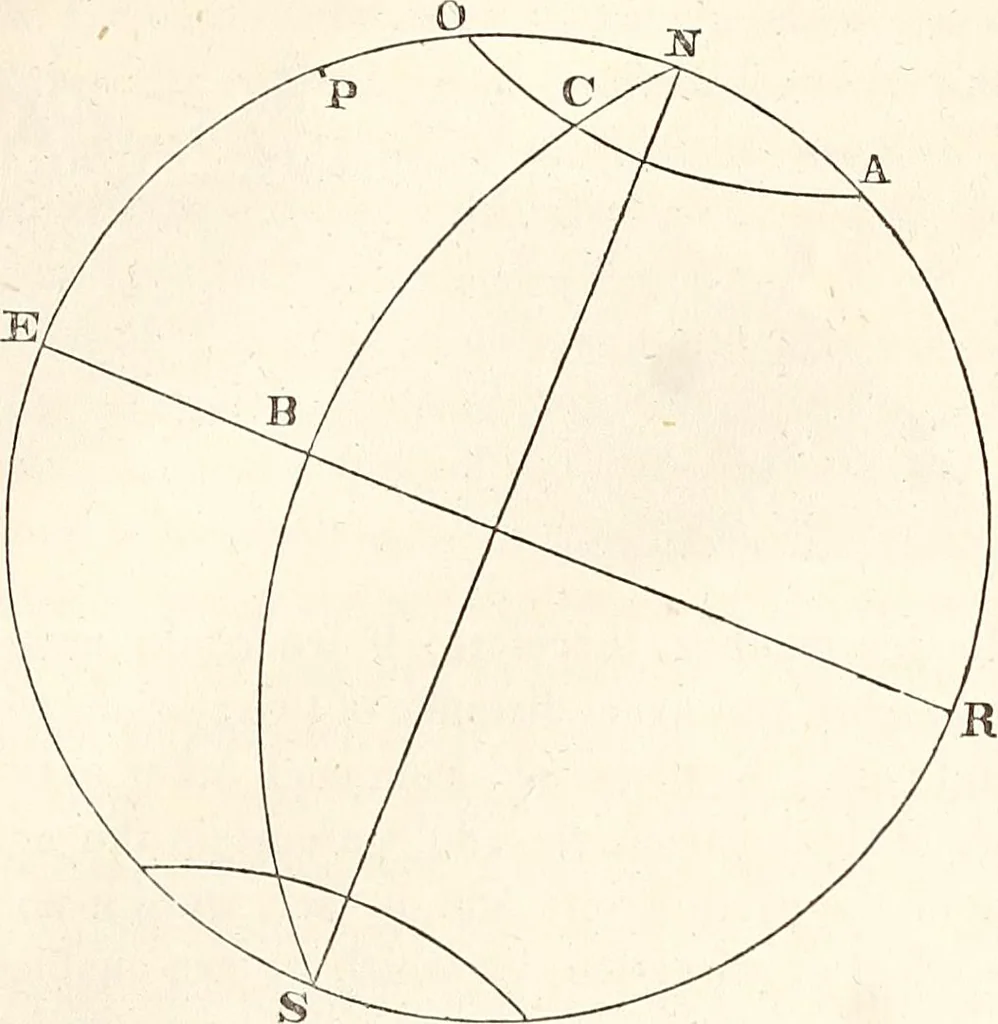
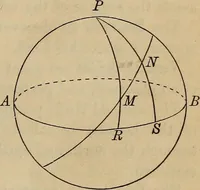
remainder is habitable. To determiine the position of any point, P, on thesurface of the earth, we draw through P and thepoles, N and S, a circle perpendicular to the equa-tor, E R. The distance P E of the point P from theequator is called its latitude. If we conceive aplane, 0 A, parallel to the… … are the only points that can have the same degreeof latitude, if we except those of a similar smallcircle drawn at an equal distance on the other sideof the equator; and in speaking of a place it isnecessary not only to indicate the degrees, but if itbe situated toward the north or the south pole.…
Astronomy
Internet Archive · Library of Congress · Public Domain Mark 1.0. Free to use for anything.