The wonders of the heavens, being a popular view of astronomy, including a full illustration of the mechanism of the heavens; embracing the sun, moon, and stars, with descriptions of the planets, comets, fixed stars, double stars, the constellations, the galaxy, or milky-way, the zodiacal light, aurora borealis, or norhtern lights, meteors, clouds, falling stars, aërolites, &c (1837)
Bradford, Duncan. [from old catalog] · Boston, American stationers company · leaf 123
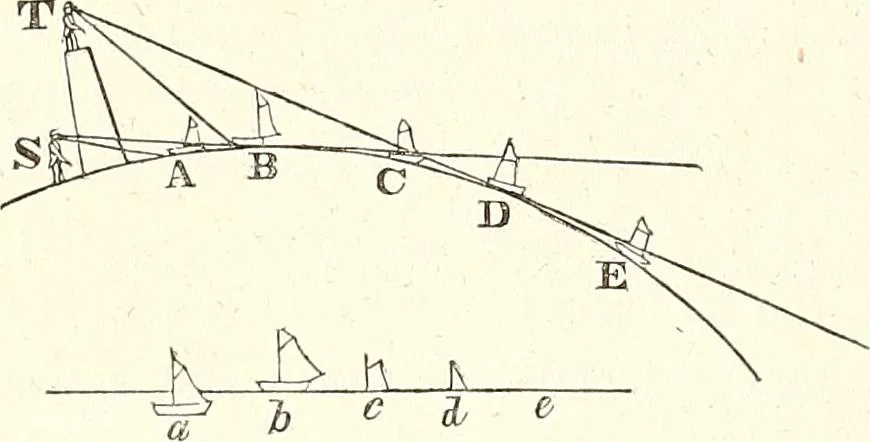
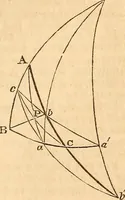
lywell beyond the offing or visible horizon, but notthe whole of them. We only see their upper parts.Their bases, where they rest on or rise out of thewater, are hid from view by the spherical surfaceof the sea, which protrudes between them and our-selves. Suppose a ship, for instance, to sail… … have prevented an equally perfect view of thewhole. rests on the sea, as at A. As it recedes it dimi-nishes, it is true, in apparent size, but still the ivholeis seen down to the water line, till it reaches thevisible horizon at B. But as soon as it has passedthis distance, not only does the…
Astronomy
Internet Archive · Library of Congress · Public Domain Mark 1.0. Free to use for anything.