The wonders of the heavens, being a popular view of astronomy, including a full illustration of the mechanism of the heavens; embracing the sun, moon, and stars, with descriptions of the planets, comets, fixed stars, double stars, the constellations, the galaxy, or milky-way, the zodiacal light, aurora borealis, or norhtern lights, meteors, clouds, falling stars, aërolites, &c (1837)
Bradford, Duncan. [from old catalog] · Boston, American stationers company · leaf 160
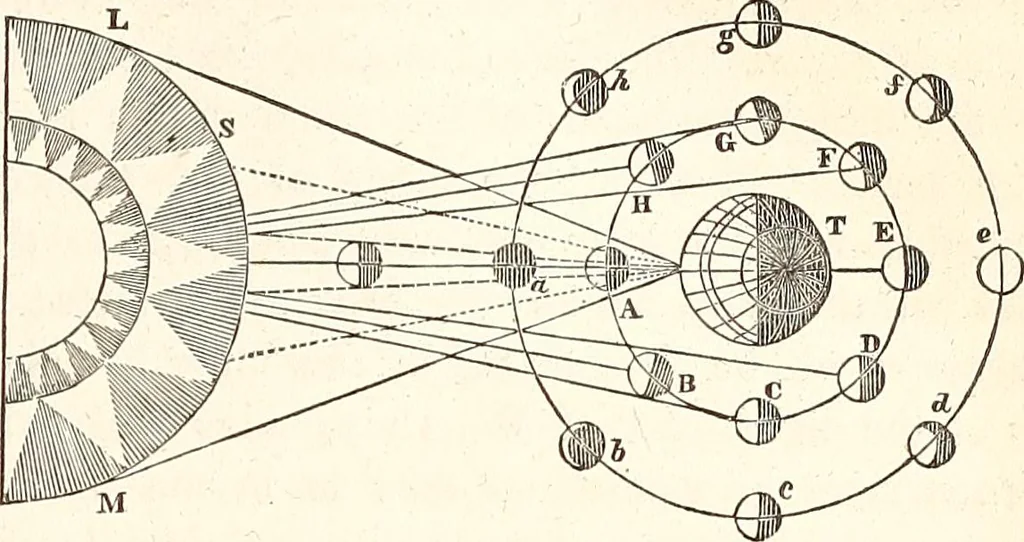
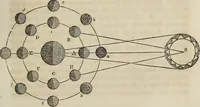
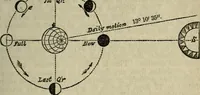
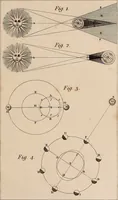
sunand earth, or the whole of the enlightened portionwould be visible to us. From this time she would again approach the sun, and some part of the en-lightened portion would continually disappear; andas the quantity visible would depend merely on therelative positions of the sun, moon, and earth,… … Let T represent the earth, S the sun, (of which,however, the distance must be taken to be verygreat, although it is not represented so for the con-venience of the figure,) and A, B, C, D, E, &c.,different positions of the moon (which we will sup-pose spherical) in her orbit. The enlightened…
Astronomy
Internet Archive · Library of Congress · Public Domain Mark 1.0. Free to use for anything.