The wonders of the heavens, being a popular view of astronomy, including a full illustration of the mechanism of the heavens; embracing the sun, moon, and stars, with descriptions of the planets, comets, fixed stars, double stars, the constellations, the galaxy, or milky-way, the zodiacal light, aurora borealis, or norhtern lights, meteors, clouds, falling stars, aërolites, &c (1837)
Bradford, Duncan. [from old catalog] · Boston, American stationers company · leaf 276
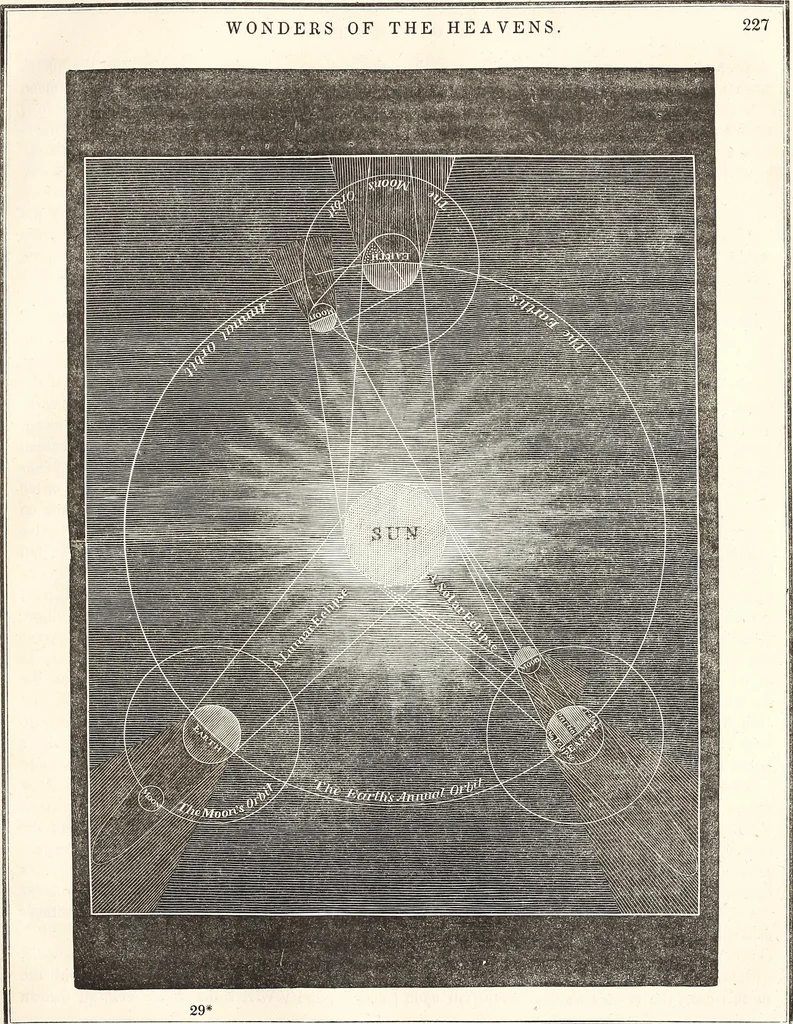
shadowmerely, nor until some part of thai luminary isentirely darkened. The lunar ecliptic limits,therefore, are not affected by them. But it is ofimportance to observe that the penumbra does exist,and that in proportion as the moon is nearer theabsolute shadow, the proportion of the sun obscuredto… … 228 WONDERS OFTHE HEAVENS observed during a lunar eclipse, the brilliancy of themoon decreasing near the part that has disappeared. If the earth and sun were equally large, theearths shadow would be infinitely extended, andall the way of the same size; and the planet Mars,in either of its nodes and…
Astronomy
Internet Archive · Library of Congress · Public Domain Mark 1.0. Free to use for anything.