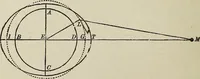
The wonders of the heavens, being a popular view of astronomy, including a full illustration of the mechanism of the heavens; embracing the sun, moon, and stars, with descriptions of the planets, comets, fixed stars, double stars, the constellations, the galaxy, or milky-way, the zodiacal light, aurora borealis, or norhtern lights, meteors, clouds, falling stars, aërolites, &c (1837)
Bradford, Duncan. [from old catalog] · Boston, American stationers company · leaf 286
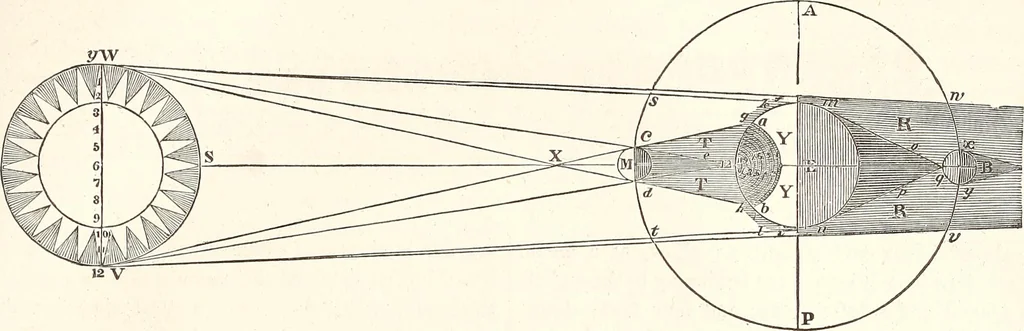
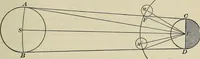
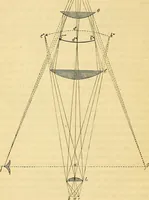
ing the longestline possible on the earth, continues the longestupon it, namely, (at a mean rate,) five hours andfifty minutes—more, if the moon be at her greatestdistance from the earth, because she then movesslowest; less, if she be at her least distance, becauseof her quicker motion. J WONDERS… … at W, touching the western side of the moon at c,and the earth at 12. Draw also the right line V c? 12from the eastern side of the sun at V, touching theeastern side of the moon at d, and the earth at 12.The dark space cel2d included between those linesis the moons shadow ending in a point at…
Astronomy
Internet Archive · Library of Congress · Public Domain Mark 1.0. Free to use for anything.