The wonders of the heavens, being a popular view of astronomy, including a full illustration of the mechanism of the heavens; embracing the sun, moon, and stars, with descriptions of the planets, comets, fixed stars, double stars, the constellations, the galaxy, or milky-way, the zodiacal light, aurora borealis, or norhtern lights, meteors, clouds, falling stars, aërolites, &c (1837)
Bradford, Duncan. [from old catalog] · Boston, American stationers company · leaf 304
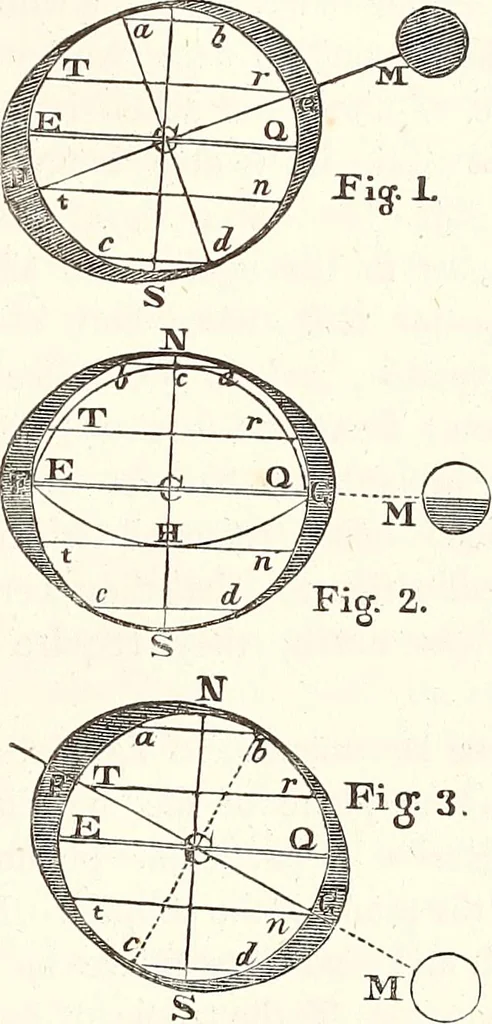
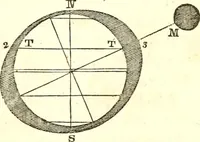
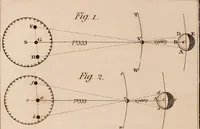
oon returns toward theequator, the parallels described by the oppositeelevations approach towards each other until themoon comes to the equator, and then they coincide.As the moon declines toward the opposite pole,at equal distances, each elevation describes thesame parallel in the other part of… … declination is south. Let N E S Q, be the earth,N C S its axis, E Q, the equator, T r the tropic ofcancer, tn the tropic of Capricorn, ab the arcticcircle, cd the antarctic, N the north pole, S thesouth pole, M the moon, F and G the two emi-nences of water, whose lowest parts are at a andd Fig. 1,…
Astronomy
Internet Archive · Library of Congress · Public Domain Mark 1.0. Free to use for anything.