The wonders of the heavens, being a popular view of astronomy, including a full illustration of the mechanism of the heavens; embracing the sun, moon, and stars, with descriptions of the planets, comets, fixed stars, double stars, the constellations, the galaxy, or milky-way, the zodiacal light, aurora borealis, or norhtern lights, meteors, clouds, falling stars, aërolites, &c (1837)
Bradford, Duncan. [from old catalog] · Boston, American stationers company · leaf 331
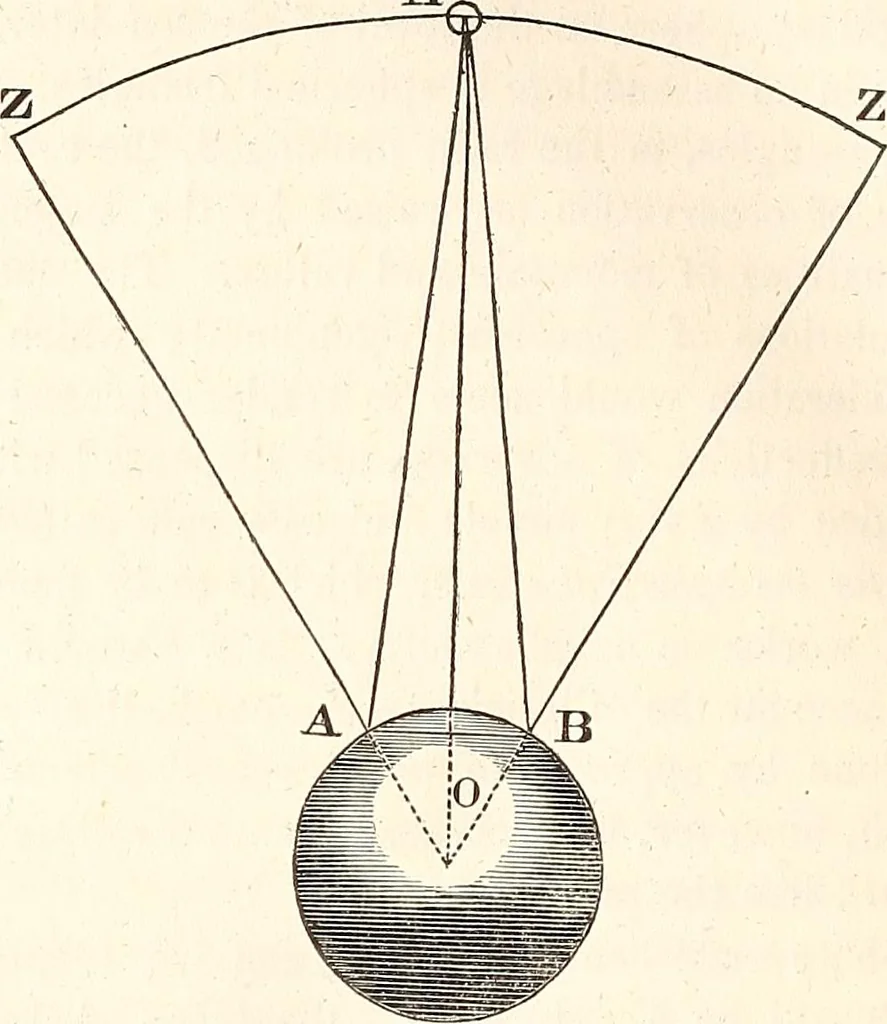
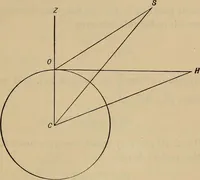
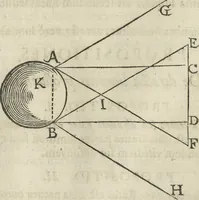
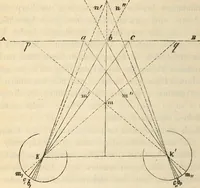
y to find the side 0 M,the moons distance. If the angle 0 be subtractedfrom ninety degrees, we shall have the angle at M,which is the moons horizontal parallax. We hopeour readers will readily comprehend this, as it isthe simplest solution the problem admits. Weshall add a more general method by… … ference of latitude, is already known; then measurethe moons distances from the zeniths Z and z atthe moment it passes the celestial meridian 2iZ.The distance M 0 of the moon may be determinedas follows ■:■— In the triangle A B 0, A 0 and 0 B are each equalto the earths semidiameter, and the angle…
Astronomy
Internet Archive · Library of Congress · Public Domain Mark 1.0. Free to use for anything.