The wonders of the heavens, being a popular view of astronomy, including a full illustration of the mechanism of the heavens; embracing the sun, moon, and stars, with descriptions of the planets, comets, fixed stars, double stars, the constellations, the galaxy, or milky-way, the zodiacal light, aurora borealis, or norhtern lights, meteors, clouds, falling stars, aërolites, &c (1837)
Bradford, Duncan. [from old catalog] · Boston, American stationers company · leaf 339
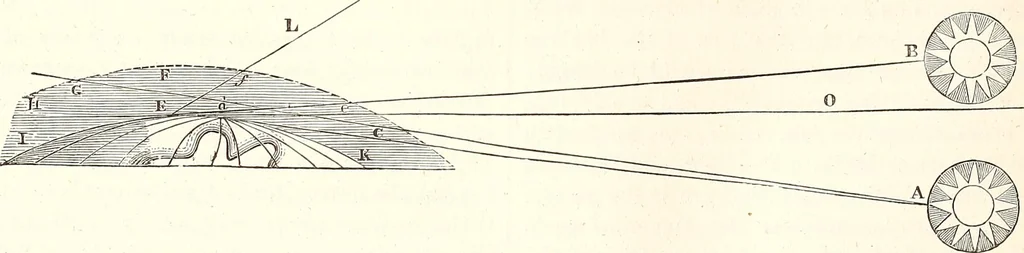
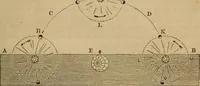
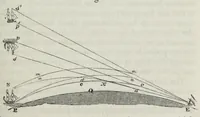
refrac-tion, are, by that effect, raised above it. The atmosphere refracts the suns rays so as tobring him in sight every clear day before he reallyrises above the horizon, and to keep him in viewfor some minutes after he is really below it. Atsome times of the year, we see the sun ten… … HGFC, and let HEO be the sensible horizonof an observer at E. When the sun is at A, reallybelow the horizon, a ray of light A C proceedingfrom him comes straight to C, where it falls on thesurface of the atmosphere, and there, entering adenser medium, it is turned out of its rectilinealcourse A C…
Astronomy
Internet Archive · Library of Congress · Public Domain Mark 1.0. Free to use for anything.