The wonders of the heavens, being a popular view of astronomy, including a full illustration of the mechanism of the heavens; embracing the sun, moon, and stars, with descriptions of the planets, comets, fixed stars, double stars, the constellations, the galaxy, or milky-way, the zodiacal light, aurora borealis, or norhtern lights, meteors, clouds, falling stars, aërolites, &c (1837)
Bradford, Duncan. [from old catalog] · Boston, American stationers company · leaf 345
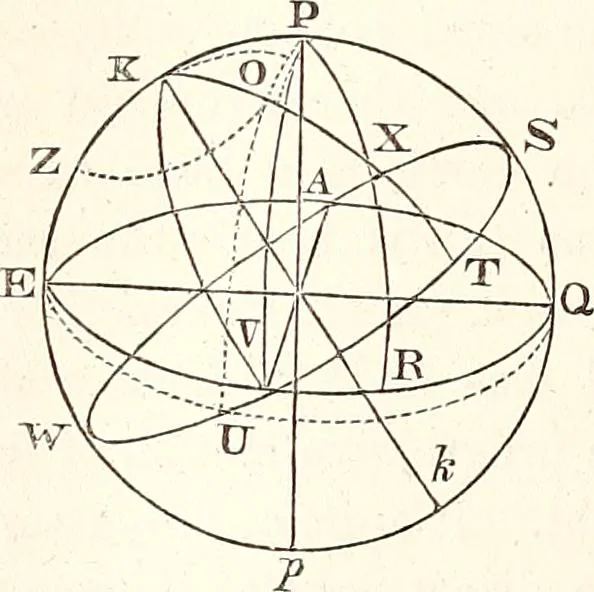
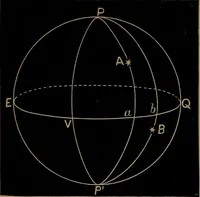
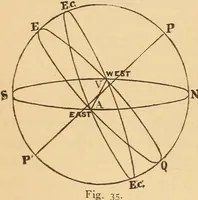
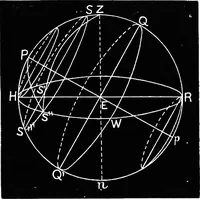
ic as acentre, keeping constantly at the same distance oftwenty-three degrees and twenty-eight minutesfrom it, in a direction from east to west, and withsuch a velocity that the annual angle described byit in this its imaginary orbit is 50M0, so thatthe whole circle would be described by it in… … of its motion in the small circle P 0 Z round K, tocome to 0, then, as the situation of the equinoctialE V Q is determined by that of the pole, this, it isevident, must cause a displacement of the equinoc-tial, which will take a new situation, E U Q,, ninetydegrees distant in every part from the…
Astronomy
Internet Archive · Library of Congress · Public Domain Mark 1.0. Free to use for anything.