The wonders of the heavens, being a popular view of astronomy, including a full illustration of the mechanism of the heavens; embracing the sun, moon, and stars, with descriptions of the planets, comets, fixed stars, double stars, the constellations, the galaxy, or milky-way, the zodiacal light, aurora borealis, or norhtern lights, meteors, clouds, falling stars, aërolites, &c (1837)
Bradford, Duncan. [from old catalog] · Boston, American stationers company · leaf 352
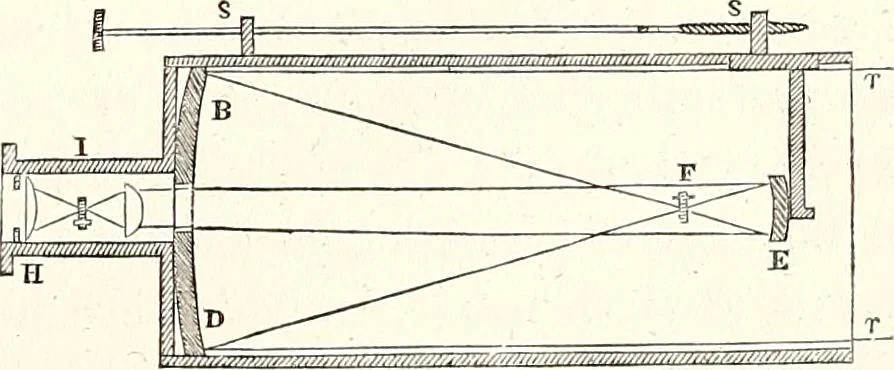
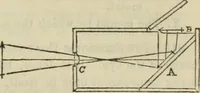
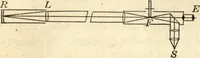
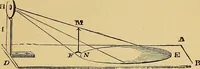
be erect, and a less quantity of light lost thanby a mirror of the common kind. Another class of reflecting telescopes was in-vented by Gregory, in 1660, but they were notmade till some years after the Newtonian, fromthe difficulty of forming the metals. The Grego-rian reflector is, however,… … Gregorian reflector. B D is a concave metal,whose surface should be formed by the revolutionof the hyperbolic curve: this speculum has asmall hole in its centre. E is another concaveelliptical small metal placed in the axis of the 304 WONDERS OF THE HEAVENS larger one, at a distance from it a…
Astronomy
Internet Archive · Library of Congress · Public Domain Mark 1.0. Free to use for anything.